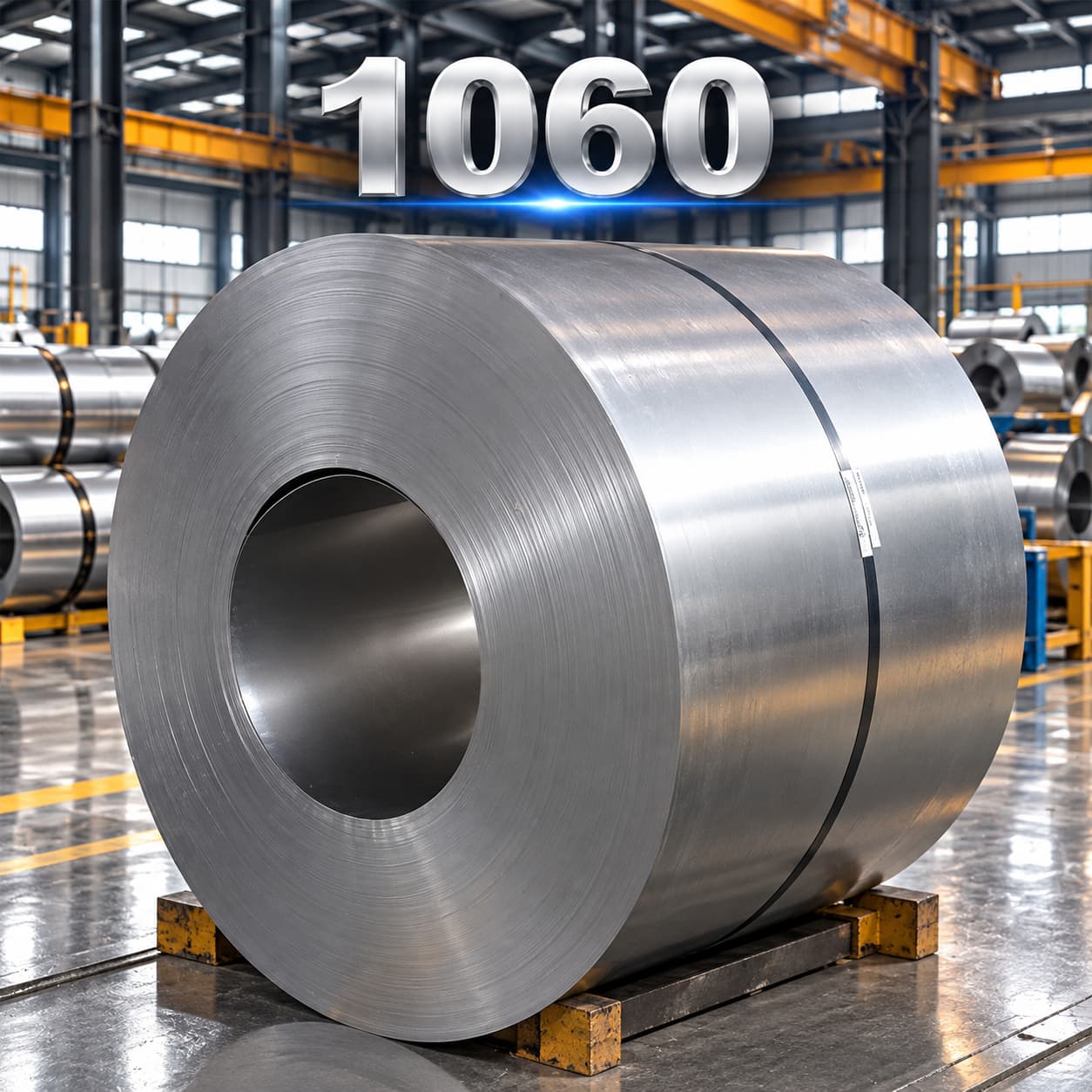
Grade: 1060
1060 is commercially pure aluminum with a minimum aluminum content of 99.60%. It provides excellent formability, good corrosion resistance and high electrical and thermal conductivity. Annealed sheet is especially suitable for deep drawing and shaping, while strain hardened tempers improve handling strength. The alloy is non heat treatable and gains strength through cold work. It is selected for conductive, chemical and fabricated sheet components where high structural strength is less important than workability and corrosion performance.
Chemical composition
Weight percent limits. Sources [1,4].
| Element | Limit wt % | Element | Limit wt % |
| Al | 99.60 min | Si | 0.25 max |
| Fe | 0.35 max | Cu | 0.05 max |
| Mn | 0.03 max | Mg | 0.03 max |
| Zn | 0.05 max | Ti | 0.03 max |
| V | 0.05 max | Other each | 0.03 max |
| Other total | — |
Mechanical properties by temper
| Temper | Thickness mm or basis | Rm MPa | Rp0.2 MPa | Elongation % |
| O | 1.5–3.0 | 60–100 | 15 min | 25 min |
| H14 | 1.5–3.0 | 95–135 | 70 min | 6 min |
| H24 | 1.5–3.0 | 95–135 | 70 min | 6 min |
| H18 | 1.5–3.0 | 125 min | 85 min | 4 min |
| O | 3.0–6.0 | 60–100 | 15 min | 25 min |
| H14 | 3.0–6.0 | 95–135 | 70 min | 10 min |
| H24 | 3.0–6.0 | 95–135 | 70 min | 10 min |
Published Yieh sheet limits. These limits are a supplier data set and must not be substituted for ASTM limits without checking the order. Elongation gauge length is not stated in the supplier table. [4]
Temper definitions
O is annealed. H14 is strain hardened to half hard; H24 is strain hardened and partially annealed to half hard; H18 is strain hardened to full hard. The same nominal hardness level does not imply identical specification limits.
Application areas
- Electrical and conductive sheet components
- Chemical industry fabricated equipment
- Deep drawn housings and formed sheet parts
- Heat transfer and thermal management components
- General corrosion resistant sheet fabrication
1060 is commercially pure aluminum with a minimum aluminum content of 99.60%. It provides excellent formability, good corrosion resistance and high electrical and thermal conductivity. Annealed sheet is especially suitable for deep drawing and shaping, while strain hardened tempers improve handling strength. The alloy is non heat treatable and gains strength through cold work. It is selected for conductive, chemical and fabricated sheet components where high structural strength is less important than workability and corrosion performance.
Chemical composition
Weight percent limits. Sources [1,4].
| Element | Limit wt % | Element | Limit wt % |
| Al | 99.60 min | Si | 0.25 max |
| Fe | 0.35 max | Cu | 0.05 max |
| Mn | 0.03 max | Mg | 0.03 max |
| Zn | 0.05 max | Ti | 0.03 max |
| V | 0.05 max | Other each | 0.03 max |
| Other total | — |
Mechanical properties by temper
| Temper | Thickness mm or basis | Rm MPa | Rp0.2 MPa | Elongation % |
| O | 1.5–3.0 | 60–100 | 15 min | 25 min |
| H14 | 1.5–3.0 | 95–135 | 70 min | 6 min |
| H24 | 1.5–3.0 | 95–135 | 70 min | 6 min |
| H18 | 1.5–3.0 | 125 min | 85 min | 4 min |
| O | 3.0–6.0 | 60–100 | 15 min | 25 min |
| H14 | 3.0–6.0 | 95–135 | 70 min | 10 min |
| H24 | 3.0–6.0 | 95–135 | 70 min | 10 min |
Published Yieh sheet limits. These limits are a supplier data set and must not be substituted for ASTM limits without checking the order. Elongation gauge length is not stated in the supplier table. [4]
Temper definitions
O is annealed. H14 is strain hardened to half hard; H24 is strain hardened and partially annealed to half hard; H18 is strain hardened to full hard. The same nominal hardness level does not imply identical specification limits.
Application areas
- Electrical and conductive sheet components
- Chemical industry fabricated equipment
- Deep drawn housings and formed sheet parts
- Heat transfer and thermal management components
- General corrosion resistant sheet fabrication
Related products
-
Aluminum
6063 Aluminum Plate/Sheet
-
Aluminum
6061 Aluminum Plate/Sheet
-
Aluminum
5754 Aluminum Sheet and Plate
-
Aluminum
5083 Aluminum Sheet and Plate
-
Aluminum
3003 Aluminum Sheet and Plate
-
Aluminum
2024 Aluminum Sheet and Plate