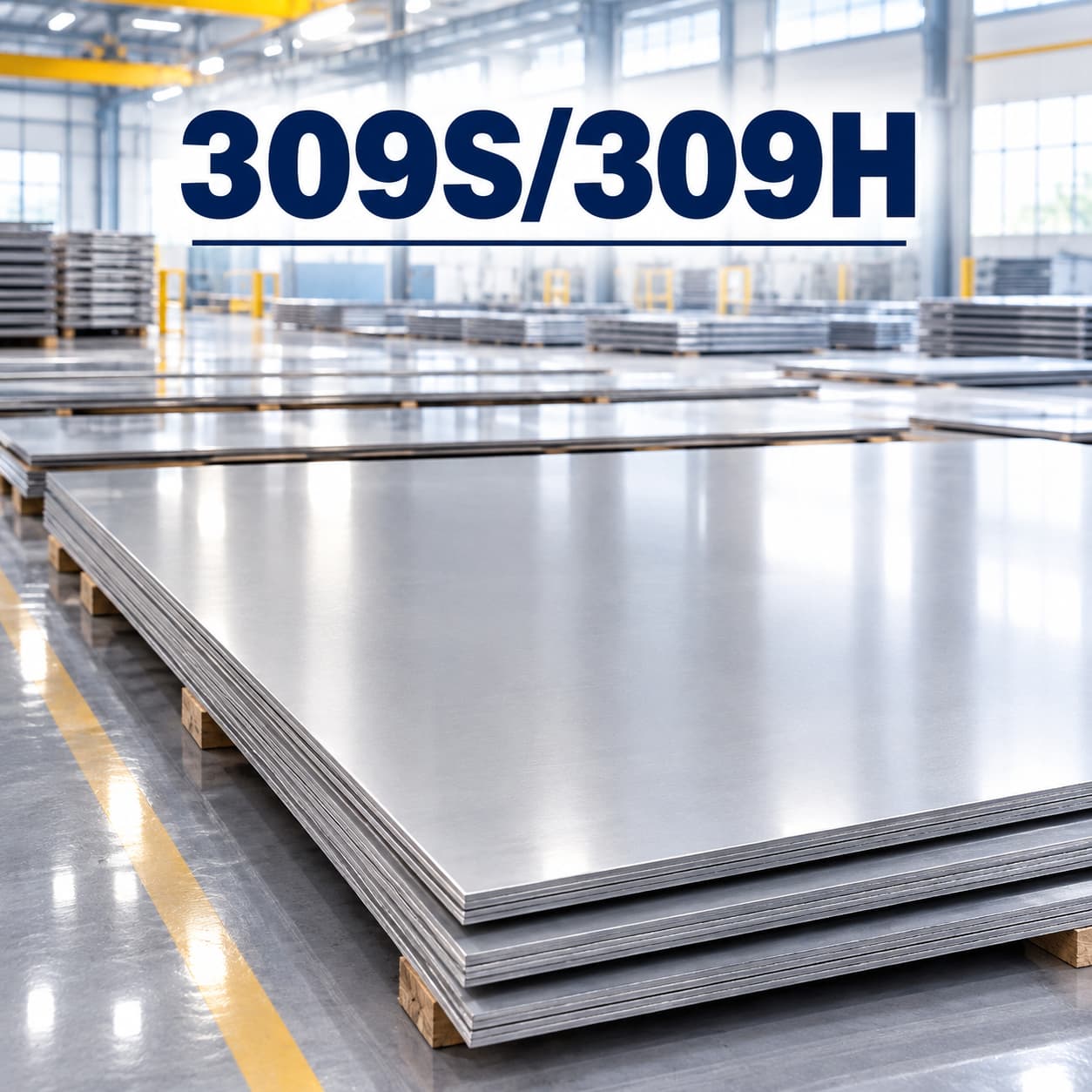
Grade: 309S/309H
Alloy 309 (UNS S30900) is an austenitic stainless steel developed for use in high temperature corrosion resistance applications. The alloy resists oxidation up to 1900°F (1038°C) under non-cyclic conditions. Frequent thermal cycling reduces oxidation resistance to approximately 1850°F (1010°C).
Because of its high chromium and low nickel content, Alloy 309 can be utilized in sulfur containing atmospheres up to 1832°F (1000°C). The alloy is not recommended for use in highly carburizing atmospheres since it exhibits only moderate resistance to carbon absorption. Alloy 309 can be utilized in slightly oxidizing, nitriding, cementing and thermal cycling applications, albeit, the maximum service temperature must be reduced.
When heated between 1202 – 1742°F (650 – 950°C) the alloy is subject to sigma phase precipitation. A solution annealing treatment at 2012 – 2102°F (1100 – 1150°C) will restore a degree of toughness.
309S (UNS S30908) is the low carbon version of the alloy. It is utilized for ease of fabrication. 309H (UNS S30909) is a high carbon modification developed for enhanced creep resistance. In most instances the grain size and carbon content of the plate can meet both the 309S and 309H requirements.
Alloy 309 can be easily welded and processed by standard shop fabrication practices.
Alloy 309 is not designed for service in wet corrosive environments. The high carbon content, which is present to enhance creep properties, has a detrimental effect on aqueous corrosion resistance. The alloy is prone to intergranular corrosion after long term exposure at high temperatures. However, due to its high chromium content (23%), Alloy 309 is more corrosion resistant than most heat resistant alloys.
High Temperature Corrosion
Alloy 309 resists high temperature corrosion in most in-service conditions. Operating temperatures are as follows:
Oxidizing conditions (max. sulfur content – 2 g/m3)
1922°F (1050°C) continuous service
2012°F (1100°C) peak temperature
Oxidizing conditions (max. sulfur greater than 2 g/m3)
1742°F (950°C) maximum temperature
Low oxygen atmosphere (max. sulfur content – 2 g/m3)
1832°F (1000°C) maximum temperature
Nitriding or carburizing atmospheres
1562 –1742°F (850 – 950°C) maximum
| Chemical composition | 309S
(UNS S30908/ EN1.4833) |
309H
(UNS S30909) |
| Carbon, Max% | 0.08 | 0.04-0.1 |
| Manganese, Max% | 2 | 2 |
| Phosphorus, Max% | 0.045 | 0.045 |
| Sulphur, Max% | 0.03 | 0.03 |
| Silicon, Max% | 0.75 | 0.75 |
| Chromium Range% | 22.0-24.0 | 22.0-24.0 |
| Nickel Range% | 12.0-15.0 | 12.0-15.0 |
| Mechanical Properties | 309S | 309H |
| Tensile Min | 75 ksi | 75 ksi |
| Yield Min | 30 ksi | 30 ksi |
| Elongation Min | 40% | 40% |
| Hardness Max | 95 HRB | 95 HRB |
- Furnaces — burners, doors, fans, piping and recuperators
- Fluidized Bed Furnaces — grids, piping, wind boxes
- Paper Mill Equipment
- Petroleum Refining — catalytic recovery systems, recuperators
- Power Generation — pulverized coal burners, tube hangers
- Thermal Processing — annealing covers and boxes, burners grids, doors, fans, lead pans and neutral salt pots, muffles and retorts, recuperators, walking beams
- Waste Treatment — incinerators, rotary kilns and calciners
Alloy 309 (UNS S30900) is an austenitic stainless steel developed for use in high temperature corrosion resistance applications. The alloy resists oxidation up to 1900°F (1038°C) under non-cyclic conditions. Frequent thermal cycling reduces oxidation resistance to approximately 1850°F (1010°C).
Because of its high chromium and low nickel content, Alloy 309 can be utilized in sulfur containing atmospheres up to 1832°F (1000°C). The alloy is not recommended for use in highly carburizing atmospheres since it exhibits only moderate resistance to carbon absorption. Alloy 309 can be utilized in slightly oxidizing, nitriding, cementing and thermal cycling applications, albeit, the maximum service temperature must be reduced.
When heated between 1202 – 1742°F (650 – 950°C) the alloy is subject to sigma phase precipitation. A solution annealing treatment at 2012 – 2102°F (1100 – 1150°C) will restore a degree of toughness.
309S (UNS S30908) is the low carbon version of the alloy. It is utilized for ease of fabrication. 309H (UNS S30909) is a high carbon modification developed for enhanced creep resistance. In most instances the grain size and carbon content of the plate can meet both the 309S and 309H requirements.
Alloy 309 can be easily welded and processed by standard shop fabrication practices.
Alloy 309 is not designed for service in wet corrosive environments. The high carbon content, which is present to enhance creep properties, has a detrimental effect on aqueous corrosion resistance. The alloy is prone to intergranular corrosion after long term exposure at high temperatures. However, due to its high chromium content (23%), Alloy 309 is more corrosion resistant than most heat resistant alloys.
High Temperature Corrosion
Alloy 309 resists high temperature corrosion in most in-service conditions. Operating temperatures are as follows:
Oxidizing conditions (max. sulfur content – 2 g/m3)
1922°F (1050°C) continuous service
2012°F (1100°C) peak temperature
Oxidizing conditions (max. sulfur greater than 2 g/m3)
1742°F (950°C) maximum temperature
Low oxygen atmosphere (max. sulfur content – 2 g/m3)
1832°F (1000°C) maximum temperature
Nitriding or carburizing atmospheres
1562 –1742°F (850 – 950°C) maximum
| Chemical composition | 309S
(UNS S30908/ EN1.4833) |
309H
(UNS S30909) |
| Carbon, Max% | 0.08 | 0.04-0.1 |
| Manganese, Max% | 2 | 2 |
| Phosphorus, Max% | 0.045 | 0.045 |
| Sulphur, Max% | 0.03 | 0.03 |
| Silicon, Max% | 0.75 | 0.75 |
| Chromium Range% | 22.0-24.0 | 22.0-24.0 |
| Nickel Range% | 12.0-15.0 | 12.0-15.0 |
| Mechanical Properties | 309S | 309H |
| Tensile Min | 75 ksi | 75 ksi |
| Yield Min | 30 ksi | 30 ksi |
| Elongation Min | 40% | 40% |
| Hardness Max | 95 HRB | 95 HRB |
- Furnaces — burners, doors, fans, piping and recuperators
- Fluidized Bed Furnaces — grids, piping, wind boxes
- Paper Mill Equipment
- Petroleum Refining — catalytic recovery systems, recuperators
- Power Generation — pulverized coal burners, tube hangers
- Thermal Processing — annealing covers and boxes, burners grids, doors, fans, lead pans and neutral salt pots, muffles and retorts, recuperators, walking beams
- Waste Treatment — incinerators, rotary kilns and calciners