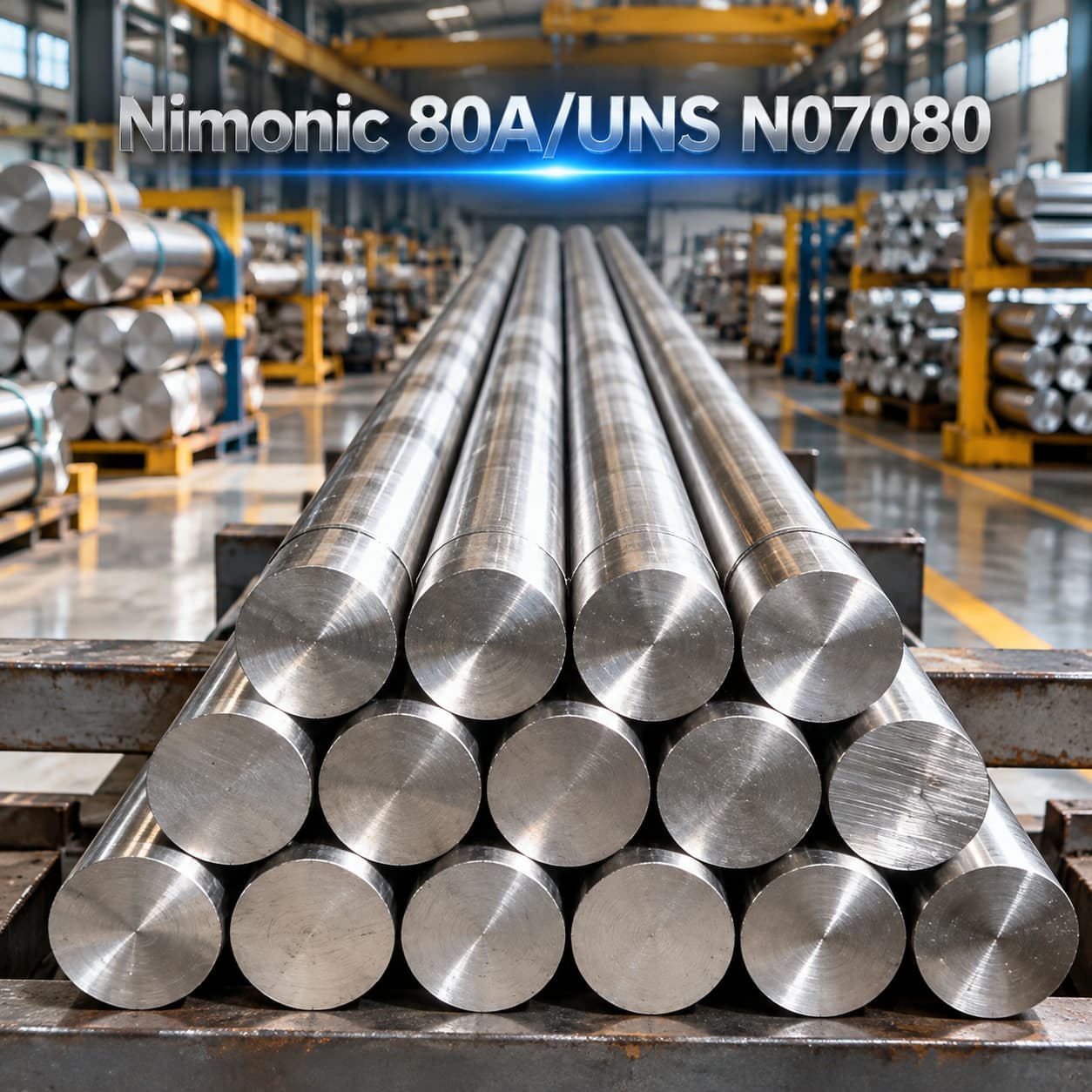
Grade: Nimonic 80A/UNS N07080
NIMONIC 80A is a wrought nickel chromium alloy strengthened by titanium and aluminium additions and subsequent aging. It combines elevated-temperature strength, creep resistance and oxidation resistance for service up to approximately 815°C. The alloy is used in turbine hardware, high-temperature fasteners and engine valves. Its performance depends on product form, melting route and the solution treatment and aging cycle selected for the component.
Chemical composition
| Element | Weight percent | Element | Weight percent |
| Ni | Balance | Cr | 18.0–21.0 |
| Ti | 1.8–2.7 | Al | 1.0–1.8 |
| Co | 2.0 max | Fe | 3.0 max |
| C | 0.10 max | Si | 1.0 max |
| Mn | 1.0 max | Cu | 0.2 max |
| B | 0.008 max | Zr | 0.15 max |
| Pb | 0.0025 max | S | 0.015 max |
Mechanical properties
Wire properties from Alloy Wire International; approximate tensile ranges, with test temperature not stated. These values are specific to wire processing and must not be applied to plate or bar.
| Wire condition | Approximate tensile strength MPa |
| Annealed | <1000 |
| Annealed and aged | 1200–1400 |
| Spring temper | 1300–1500 |
| Spring temper and aged | 1500–1800 |
ATI reports typical hardness for UNS N07080 of 91–99 HRB after solution treatment and 29–38 HRC after aging. Special Metals handbook gives typical 1000 h rupture strengths of 500 MPa at 650°C, 220 MPa at 760°C and 110 MPa at 815°C for precipitation-hardened material; product form and detailed cycle are not specified there.
Application areas
- Gas turbine blades, discs and rings
- High-temperature bolts and fasteners
- Nuclear boiler tube supports
- Die casting inserts and cores
- Automobile exhaust valves
NIMONIC 80A is a wrought nickel chromium alloy strengthened by titanium and aluminium additions and subsequent aging. It combines elevated-temperature strength, creep resistance and oxidation resistance for service up to approximately 815°C. The alloy is used in turbine hardware, high-temperature fasteners and engine valves. Its performance depends on product form, melting route and the solution treatment and aging cycle selected for the component.
Chemical composition
| Element | Weight percent | Element | Weight percent |
| Ni | Balance | Cr | 18.0–21.0 |
| Ti | 1.8–2.7 | Al | 1.0–1.8 |
| Co | 2.0 max | Fe | 3.0 max |
| C | 0.10 max | Si | 1.0 max |
| Mn | 1.0 max | Cu | 0.2 max |
| B | 0.008 max | Zr | 0.15 max |
| Pb | 0.0025 max | S | 0.015 max |
Mechanical properties
Wire properties from Alloy Wire International; approximate tensile ranges, with test temperature not stated. These values are specific to wire processing and must not be applied to plate or bar.
| Wire condition | Approximate tensile strength MPa |
| Annealed | <1000 |
| Annealed and aged | 1200–1400 |
| Spring temper | 1300–1500 |
| Spring temper and aged | 1500–1800 |
ATI reports typical hardness for UNS N07080 of 91–99 HRB after solution treatment and 29–38 HRC after aging. Special Metals handbook gives typical 1000 h rupture strengths of 500 MPa at 650°C, 220 MPa at 760°C and 110 MPa at 815°C for precipitation-hardened material; product form and detailed cycle are not specified there.
Application areas
- Gas turbine blades, discs and rings
- High-temperature bolts and fasteners
- Nuclear boiler tube supports
- Die casting inserts and cores
- Automobile exhaust valves
Related products
-
Incoloy
Alloy 909 / UNS N19909
-
Incoloy
Alloy 903 / UNS N19903
-
Incoloy
Alloy 901 / UNS N09901
-
Incoloy
Alloy 330/Incoloy 330
-
Nickel Alloy
Kovar/UNS K94610
-
Hastelloy
Alloy B-2/UNS N10665