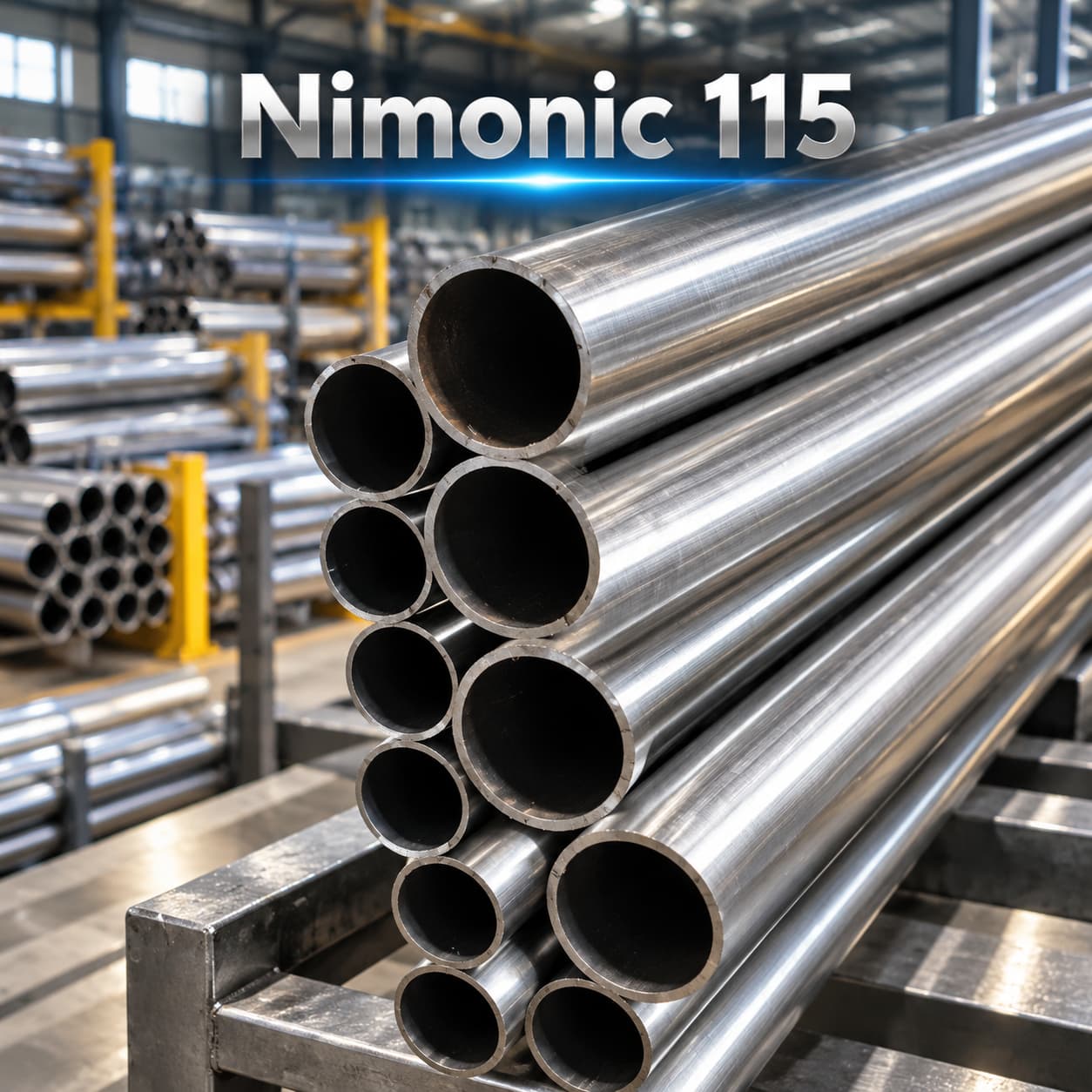
Grade: Nimonic 115/W.Nr 2.4636
NIMONIC 115 is a nickel chromium cobalt superalloy designed for heavily loaded turbine blades. Aluminum and titanium develop precipitation strengthening, while molybdenum contributes solid-solution strength. Its principal advantage is resistance to creep at very high temperatures. Product selection should account for forging practice, final aging and the operating stress, because these factors strongly influence blade life.
Chemical composition
| Element | Weight percent | Element | Weight percent |
| Ni | Balance | Cr | 14–16 |
| Co | 13–15.5 | Mo | 3–5 |
| Ti | 3.5–4.5 | Al | 4.5–5.5 |
| C | 0.12–0.20 | B | 0.010–0.025 |
| Si | 1.0 max | Mn | 1.0 max |
| Fe | 1.0 max | Cu | 0.20 max |
| Zr | 0.15 max | Pb | 0.0015 max |
| S | 0.015 max | — | — |
Mechanical properties
Typical 1,000-hour rupture strength, precipitation-hardened condition; Special Metals handbook, printed page 30. The handbook does not specify the product form or exact aging cycle for these values.
| Test temperature °C | 1,000 h rupture strength MPa |
| 760 | 450 |
| 815 | 310 |
| 870 | 210 |
| 925 | 130 |
| 980 | 80 |
These stresses correspond to rupture in approximately 1,000 hours. They are not tensile strengths or allowable design stresses. The bulletin presents tensile properties graphically; numerical values are not inferred here.
Application areas
- Aircraft gas turbine blades
- Forged or machined turbine blading requiring high creep strength
NIMONIC 115 is a nickel chromium cobalt superalloy designed for heavily loaded turbine blades. Aluminum and titanium develop precipitation strengthening, while molybdenum contributes solid-solution strength. Its principal advantage is resistance to creep at very high temperatures. Product selection should account for forging practice, final aging and the operating stress, because these factors strongly influence blade life.
Chemical composition
| Element | Weight percent | Element | Weight percent |
| Ni | Balance | Cr | 14–16 |
| Co | 13–15.5 | Mo | 3–5 |
| Ti | 3.5–4.5 | Al | 4.5–5.5 |
| C | 0.12–0.20 | B | 0.010–0.025 |
| Si | 1.0 max | Mn | 1.0 max |
| Fe | 1.0 max | Cu | 0.20 max |
| Zr | 0.15 max | Pb | 0.0015 max |
| S | 0.015 max | — | — |
Mechanical properties
Typical 1,000-hour rupture strength, precipitation-hardened condition; Special Metals handbook, printed page 30. The handbook does not specify the product form or exact aging cycle for these values.
| Test temperature °C | 1,000 h rupture strength MPa |
| 760 | 450 |
| 815 | 310 |
| 870 | 210 |
| 925 | 130 |
| 980 | 80 |
These stresses correspond to rupture in approximately 1,000 hours. They are not tensile strengths or allowable design stresses. The bulletin presents tensile properties graphically; numerical values are not inferred here.
Application areas
- Aircraft gas turbine blades
- Forged or machined turbine blading requiring high creep strength
Related products
-
Incoloy
Alloy 825 / UNS N08825
-
Incoloy
Alloy 28 / UNS N08028
-
Nickel Alloy
Nickel 205/UNS N02205
-
Hastelloy
Alloy C276/UNS N10276
-
Hastelloy
Alloy B-3/UNS N10675