Grade: 321/UNS S32100
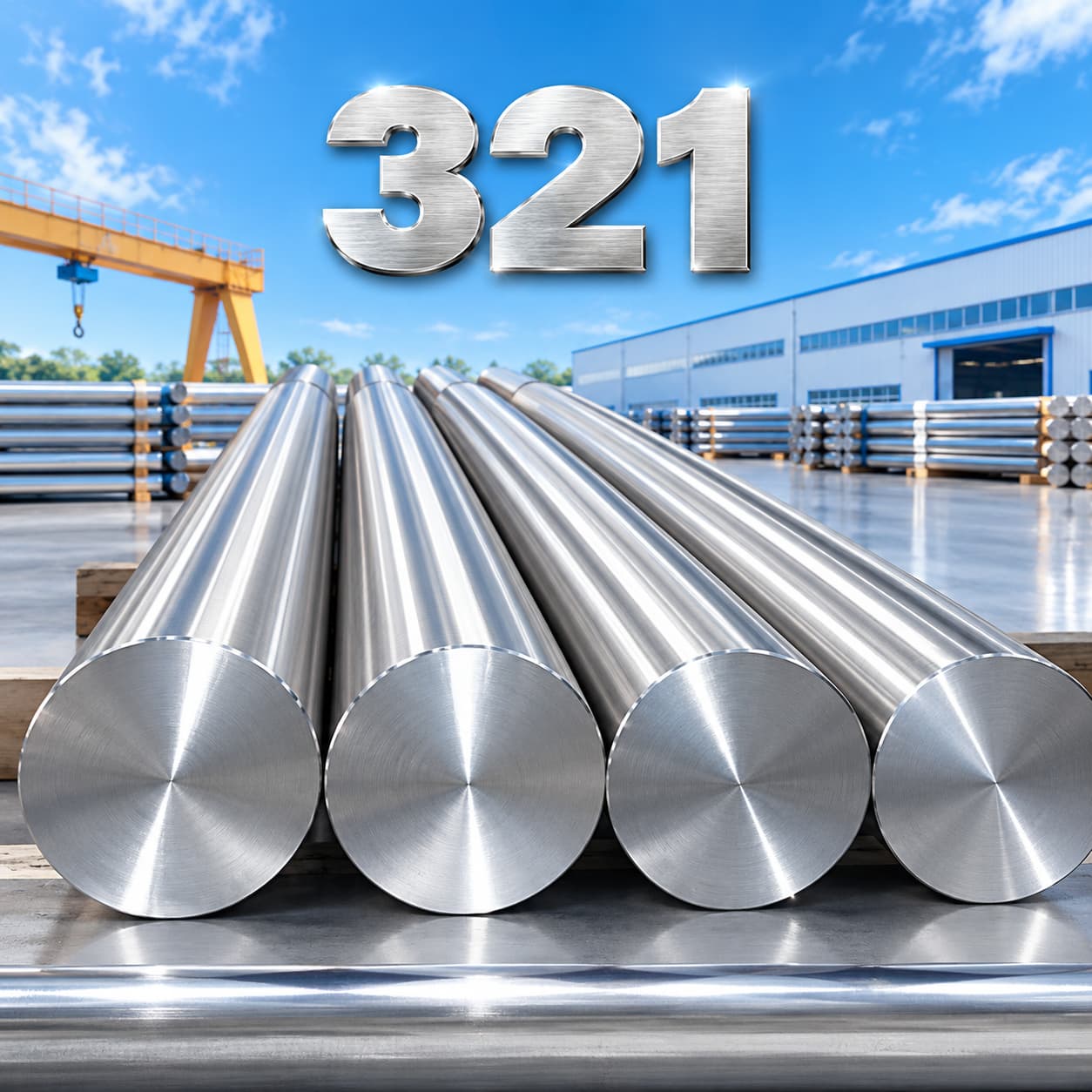
321 stainless steel is a titanium-stabilized austenitic chromium-nickel stainless steel grade designated as UNS S32100. It was developed to provide improved resistance to intergranular corrosion after exposure to high temperatures during welding or service. The addition of titanium stabilizes the carbon content by forming titanium carbide, preventing chromium carbide precipitation at grain boundaries and maintaining corrosion resistance in welded structures.
The alloy contains chromium and nickel as the primary alloying elements, with titanium added as a stabilizing element. Chromium provides excellent oxidation resistance and general corrosion resistance by forming a protective passive oxide layer. Nickel maintains the stable austenitic structure, improving toughness, ductility, and resistance to thermal cycling. Titanium enhances resistance to sensitization and allows the material to operate effectively in high-temperature environments.
321 stainless steel bars maintain good mechanical strength, creep resistance, and oxidation resistance at elevated temperatures. The material performs well under continuous service conditions up to approximately 870°C and intermittent service conditions at higher temperatures. It offers excellent weldability, good forming characteristics, and stable performance after fabrication.
321 stainless steel bars are widely used in aerospace components, heat exchangers, furnace equipment, chemical processing systems, exhaust manifolds, pressure vessels, and high-temperature industrial applications. It is especially suitable for components exposed to repeated heating and cooling cycles where conventional stainless steels may suffer from intergranular corrosion.
ASTM / JIS / EN Standards
| Standard System | Standard / Grade | Description |
| ASTM | ASTM A276 / A276M – UNS S32100 | Stainless Steel Bars and Shapes |
| ASTM | ASTM A479 / A479M – UNS S32100 | Stainless Steel Bars for Pressure Equipment |
| UNS | S32100 | 321 Stainless Steel Grade |
| JIS | JIS G4303 SUS321 | Stainless Steel Bars |
| EN | EN 10088-3 1.4541 | X6CrNiTi18-10 Stainless Steel |
| DIN | DIN 1.4541 | Equivalent European Material Designation |
Stainless Steel Bar Execution Standards
| Item | Specification |
| Product Type | Round Bar, Square Bar, Hexagonal Bar |
| Manufacturing Process | Hot Rolled, Cold Drawn, Peeled, Ground, Polished |
| Heat Treatment | Solution Annealing |
| Heat Treatment Temperature | Approximately 950–1120°C followed by rapid cooling |
| Surface Condition | Black Surface, Bright Surface, Ground Surface, Polished Surface |
| Dimensional Tolerance | According to ASTM A276 / customer requirements |
| Inspection | Chemical Analysis, Mechanical Testing, Dimensional Inspection |
| Supply Condition | Solution Annealed, Cold Finished, Machined Condition |
Chemical Composition (%)
| Element | Composition Requirement |
| Carbon (C) | ≤ 0.08 |
| Silicon (Si) | ≤ 1.00 |
| Manganese (Mn) | ≤ 2.00 |
| Phosphorus (P) | ≤ 0.045 |
| Sulfur (S) | ≤ 0.030 |
| Chromium (Cr) | 17.00 – 19.00 |
| Nickel (Ni) | 9.00 – 12.00 |
| Titanium (Ti) | ≥ 5 × C (max 0.70) |
| Nitrogen (N) | ≤ 0.10 |
| Iron (Fe) | Balance |
Mechanical Properties (Annealed Condition)
| Property | Requirement |
| Tensile Strength | ≥ 515 MPa |
| Yield Strength (0.2% Offset) | ≥ 205 MPa |
| Elongation | ≥ 40% |
| Hardness | ≤ 217 HB (Typical) |
| Condition | Solution Annealed |
| Industry | Applications |
| Aerospace Industry | Aircraft engine components, exhaust systems |
| Chemical Industry | Chemical processing equipment, piping systems |
| Heat Treatment Industry | Furnace parts, heating equipment |
| Energy Industry | Heat exchangers, boiler components |
| Automotive Industry | Exhaust manifolds and high-temperature parts |
| Pressure Equipment | Pressure vessels and high-temperature piping |
| Mechanical Engineering | Precision machined heat-resistant components |
321 stainless steel is a titanium-stabilized austenitic chromium-nickel stainless steel grade designated as UNS S32100. It was developed to provide improved resistance to intergranular corrosion after exposure to high temperatures during welding or service. The addition of titanium stabilizes the carbon content by forming titanium carbide, preventing chromium carbide precipitation at grain boundaries and maintaining corrosion resistance in welded structures.
The alloy contains chromium and nickel as the primary alloying elements, with titanium added as a stabilizing element. Chromium provides excellent oxidation resistance and general corrosion resistance by forming a protective passive oxide layer. Nickel maintains the stable austenitic structure, improving toughness, ductility, and resistance to thermal cycling. Titanium enhances resistance to sensitization and allows the material to operate effectively in high-temperature environments.
321 stainless steel bars maintain good mechanical strength, creep resistance, and oxidation resistance at elevated temperatures. The material performs well under continuous service conditions up to approximately 870°C and intermittent service conditions at higher temperatures. It offers excellent weldability, good forming characteristics, and stable performance after fabrication.
321 stainless steel bars are widely used in aerospace components, heat exchangers, furnace equipment, chemical processing systems, exhaust manifolds, pressure vessels, and high-temperature industrial applications. It is especially suitable for components exposed to repeated heating and cooling cycles where conventional stainless steels may suffer from intergranular corrosion.
ASTM / JIS / EN Standards
| Standard System | Standard / Grade | Description |
| ASTM | ASTM A276 / A276M – UNS S32100 | Stainless Steel Bars and Shapes |
| ASTM | ASTM A479 / A479M – UNS S32100 | Stainless Steel Bars for Pressure Equipment |
| UNS | S32100 | 321 Stainless Steel Grade |
| JIS | JIS G4303 SUS321 | Stainless Steel Bars |
| EN | EN 10088-3 1.4541 | X6CrNiTi18-10 Stainless Steel |
| DIN | DIN 1.4541 | Equivalent European Material Designation |
Stainless Steel Bar Execution Standards
| Item | Specification |
| Product Type | Round Bar, Square Bar, Hexagonal Bar |
| Manufacturing Process | Hot Rolled, Cold Drawn, Peeled, Ground, Polished |
| Heat Treatment | Solution Annealing |
| Heat Treatment Temperature | Approximately 950–1120°C followed by rapid cooling |
| Surface Condition | Black Surface, Bright Surface, Ground Surface, Polished Surface |
| Dimensional Tolerance | According to ASTM A276 / customer requirements |
| Inspection | Chemical Analysis, Mechanical Testing, Dimensional Inspection |
| Supply Condition | Solution Annealed, Cold Finished, Machined Condition |
Chemical Composition (%)
| Element | Composition Requirement |
| Carbon (C) | ≤ 0.08 |
| Silicon (Si) | ≤ 1.00 |
| Manganese (Mn) | ≤ 2.00 |
| Phosphorus (P) | ≤ 0.045 |
| Sulfur (S) | ≤ 0.030 |
| Chromium (Cr) | 17.00 – 19.00 |
| Nickel (Ni) | 9.00 – 12.00 |
| Titanium (Ti) | ≥ 5 × C (max 0.70) |
| Nitrogen (N) | ≤ 0.10 |
| Iron (Fe) | Balance |
Mechanical Properties (Annealed Condition)
| Property | Requirement |
| Tensile Strength | ≥ 515 MPa |
| Yield Strength (0.2% Offset) | ≥ 205 MPa |
| Elongation | ≥ 40% |
| Hardness | ≤ 217 HB (Typical) |
| Condition | Solution Annealed |
| Industry | Applications |
| Aerospace Industry | Aircraft engine components, exhaust systems |
| Chemical Industry | Chemical processing equipment, piping systems |
| Heat Treatment Industry | Furnace parts, heating equipment |
| Energy Industry | Heat exchangers, boiler components |
| Automotive Industry | Exhaust manifolds and high-temperature parts |
| Pressure Equipment | Pressure vessels and high-temperature piping |
| Mechanical Engineering | Precision machined heat-resistant components |