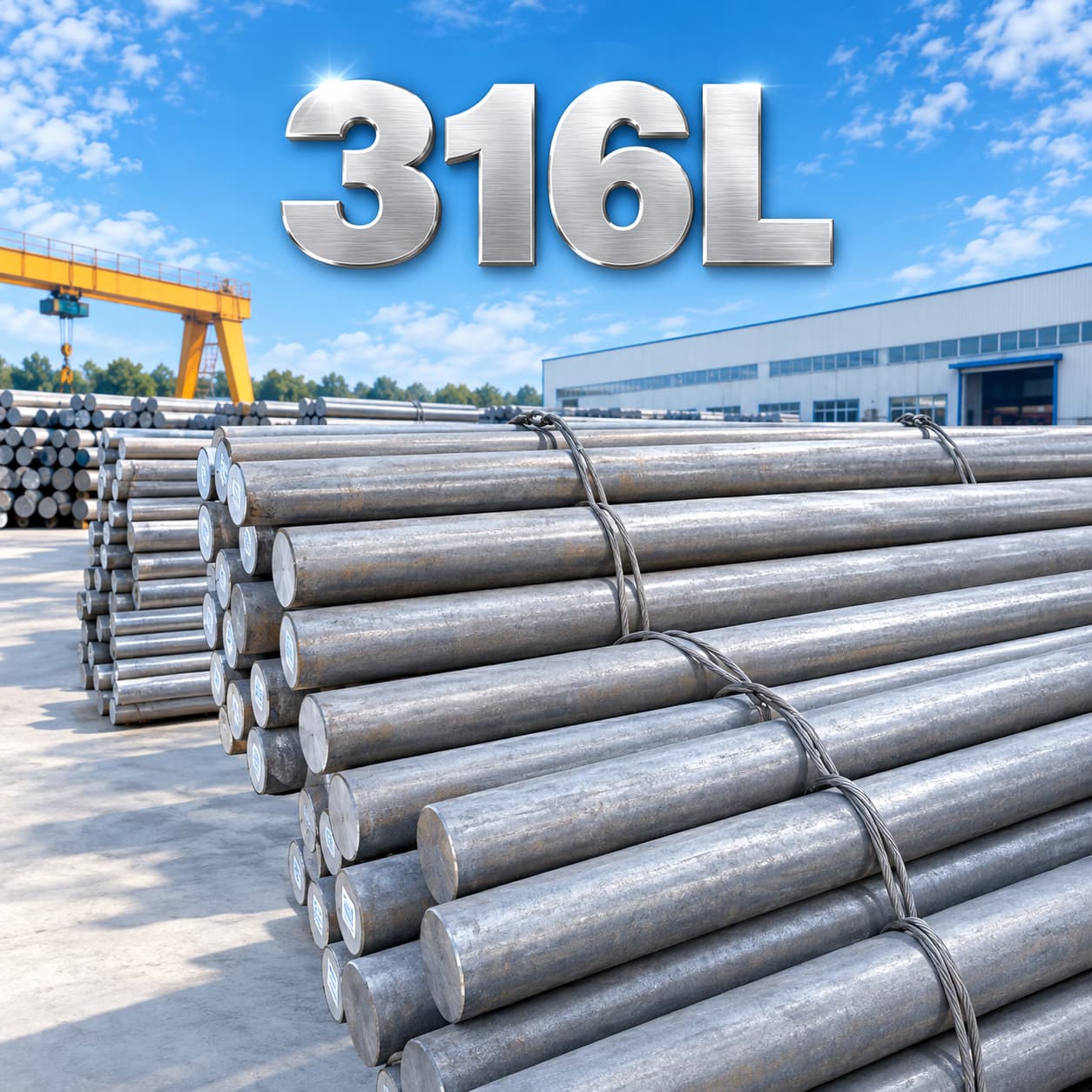
Grade: 316L/UNS S31603
316L stainless steel is a low-carbon molybdenum-bearing austenitic stainless steel developed from 316 stainless steel.
The reduced carbon content, typically limited to a maximum of 0.03%, minimizes chromium carbide precipitation during welding
and prolonged exposure to elevated temperatures. This improves resistance to intergranular corrosion and makes 316L an excellent
choice for welded structures and equipment where post-weld heat treatment is not practical.
The addition of molybdenum provides significantly improved resistance to pitting and crevice corrosion, especially in chloride-containing
environments. Chromium provides the passive oxide film for general corrosion protection, while nickel stabilizes the austenitic structure
and contributes to excellent toughness, ductility, and fabrication performance.
Compared with 316 stainless steel, 316L offers improved weldability and corrosion resistance after welding, while maintaining similar
mechanical properties and service performance. It has excellent forming characteristics, good machinability, and outstanding toughness
at both ambient and low temperatures. The material remains non-magnetic in the annealed condition.
316L stainless steel is widely used in chemical processing, pharmaceutical equipment, food processing systems, marine applications,
heat exchangers, pressure vessels, piping systems, and stainless steel bar applications such as shafts, valves, fittings, and fasteners
where superior corrosion resistance and long-term reliability are required.
Standard Designations
| Standard | Designation |
| ASTM / UNS | Type 316L / UNS S31603 |
| JIS | SUS316L |
| EN | 1.4404 / X2CrNiMo17-12-2 |
Bar Production Standards
| Standard | Description |
| ASTM A276/A276M | Stainless Steel Bars and Shapes |
| ASTM A479/A479M | Stainless Steel Bars and Shapes for Pressure Vessel Service |
| ASTM A484/A484M | General Requirements for Stainless Steel Bars |
| JIS G4303 | Stainless Steel Bars |
| EN 10088-3 | Stainless Steel Bars and Rods |
Chemical Composition (Typical wt.%)
| Element | Value |
| Carbon (C) | ≤0.030 |
| Chromium (Cr) | 16.00-18.00 |
| Nickel (Ni) | 10.00-14.00 |
| Molybdenum (Mo) | 2.00-3.00 |
| Manganese (Mn) | ≤2.00 |
| Silicon (Si) | ≤1.00 |
| Phosphorus (P) | ≤0.045 |
| Sulfur (S) | ≤0.030 |
| Nitrogen (N) | ≤0.10 |
| Iron (Fe) | Balance |
Mechanical Properties (Annealed Condition)
| Property | Value |
| Tensile Strength | ≥485 MPa |
| Yield Strength (0.2% Offset) | ≥170 MPa |
| Elongation | ≥40% |
| Hardness (Brinell) | ≤217 HB |
| Hardness (Rockwell B) | ≤95 HRB |
| Density | Approx. 8.0 g/cm³ |
| Modulus of Elasticity | Approx. 193 GPa |
- Chemical processing equipment
- Pharmaceutical equipment
- Food and beverage processing equipment
- Marine components
- Heat exchangers
- Pressure vessels
- Welded piping systems
- Pumps and valves
- Stainless steel shafts, fittings, and fasteners
316L stainless steel is a low-carbon molybdenum-bearing austenitic stainless steel developed from 316 stainless steel.
The reduced carbon content, typically limited to a maximum of 0.03%, minimizes chromium carbide precipitation during welding
and prolonged exposure to elevated temperatures. This improves resistance to intergranular corrosion and makes 316L an excellent
choice for welded structures and equipment where post-weld heat treatment is not practical.
The addition of molybdenum provides significantly improved resistance to pitting and crevice corrosion, especially in chloride-containing
environments. Chromium provides the passive oxide film for general corrosion protection, while nickel stabilizes the austenitic structure
and contributes to excellent toughness, ductility, and fabrication performance.
Compared with 316 stainless steel, 316L offers improved weldability and corrosion resistance after welding, while maintaining similar
mechanical properties and service performance. It has excellent forming characteristics, good machinability, and outstanding toughness
at both ambient and low temperatures. The material remains non-magnetic in the annealed condition.
316L stainless steel is widely used in chemical processing, pharmaceutical equipment, food processing systems, marine applications,
heat exchangers, pressure vessels, piping systems, and stainless steel bar applications such as shafts, valves, fittings, and fasteners
where superior corrosion resistance and long-term reliability are required.
Standard Designations
| Standard | Designation |
| ASTM / UNS | Type 316L / UNS S31603 |
| JIS | SUS316L |
| EN | 1.4404 / X2CrNiMo17-12-2 |
Bar Production Standards
| Standard | Description |
| ASTM A276/A276M | Stainless Steel Bars and Shapes |
| ASTM A479/A479M | Stainless Steel Bars and Shapes for Pressure Vessel Service |
| ASTM A484/A484M | General Requirements for Stainless Steel Bars |
| JIS G4303 | Stainless Steel Bars |
| EN 10088-3 | Stainless Steel Bars and Rods |
Chemical Composition (Typical wt.%)
| Element | Value |
| Carbon (C) | ≤0.030 |
| Chromium (Cr) | 16.00-18.00 |
| Nickel (Ni) | 10.00-14.00 |
| Molybdenum (Mo) | 2.00-3.00 |
| Manganese (Mn) | ≤2.00 |
| Silicon (Si) | ≤1.00 |
| Phosphorus (P) | ≤0.045 |
| Sulfur (S) | ≤0.030 |
| Nitrogen (N) | ≤0.10 |
| Iron (Fe) | Balance |
Mechanical Properties (Annealed Condition)
| Property | Value |
| Tensile Strength | ≥485 MPa |
| Yield Strength (0.2% Offset) | ≥170 MPa |
| Elongation | ≥40% |
| Hardness (Brinell) | ≤217 HB |
| Hardness (Rockwell B) | ≤95 HRB |
| Density | Approx. 8.0 g/cm³ |
| Modulus of Elasticity | Approx. 193 GPa |
- Chemical processing equipment
- Pharmaceutical equipment
- Food and beverage processing equipment
- Marine components
- Heat exchangers
- Pressure vessels
- Welded piping systems
- Pumps and valves
- Stainless steel shafts, fittings, and fasteners