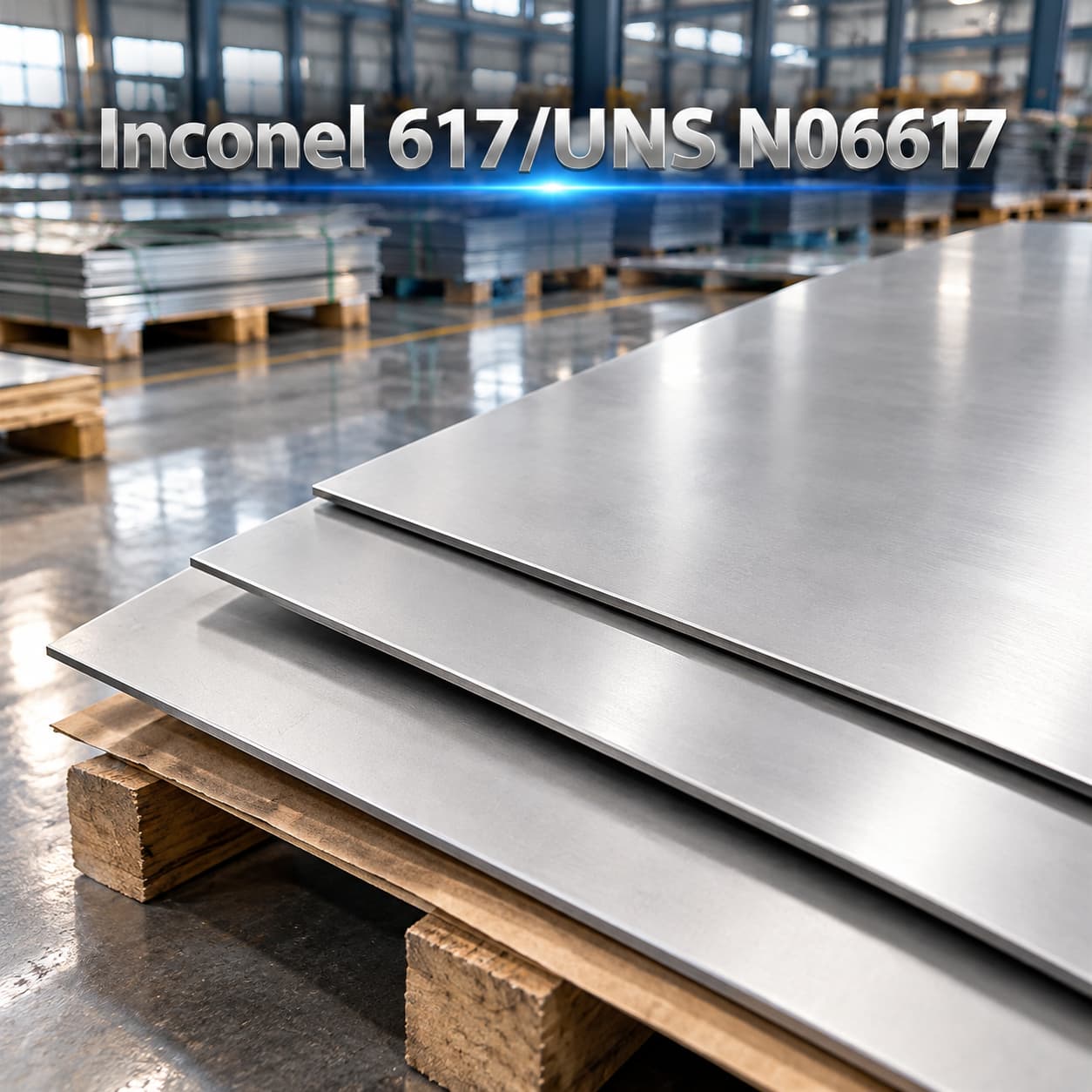
Grade: Inconel 617/UNS N06617/Alloy 617/Nickel Alloy 617/AIT 617/W.Nr. 2.4663/NCF617/NiCr23Co12Mo/NiCr22Co12Mo9
INCONEL 617 is a nickel chromium cobalt molybdenum alloy intended for demanding thermal service. It combines solid-solution strength with resistance to oxidation and a range of corrosive environments. Conventional forming and welding methods can produce complex components from several mill forms. Applications emphasize sustained elevated-temperature loading, making creep behavior, fabrication history and the selected solution treatment central to material qualification.
Chemical composition
| Element | Weight percent | Element | Weight percent |
| Ni | 44.5 min | Cr | 20–24 |
| Co | 10–15 | Mo | 8–10 |
| Al | 0.8–1.5 | C | 0.05–0.15 |
| Fe | 3.0 max | Mn | 1.0 max |
| Si | 1.0 max | S | 0.015 max |
| Ti | 0.60 max | Cu | 0.50 max |
| B | 0.006 max | — | — |
Mechanical properties
Typical room-temperature properties of solution-annealed material, Special Metals Table 5. Flat-product results are transverse to rolling.
| Product form | 0.2% yield MPa | Tensile MPa | Elongation % |
| Hot-rolled plate | 322 | 734 | 62 |
| Hot-rolled bar | 318 | 769 | 56 |
| Cold-drawn tubing | 383 | 758 | 56 |
| Cold-rolled sheet / strip | 351 | 755 | 58 |
The summary table does not state an exact solution-annealing cycle. Do not equate these typical values with standard minima or allowable design stresses.
Application areas
- Gas turbine ducting, combustion cans and transition liners
- High-temperature heat-exchange equipment
- Chemical-process and power-generation thermal equipment
INCONEL 617 is a nickel chromium cobalt molybdenum alloy intended for demanding thermal service. It combines solid-solution strength with resistance to oxidation and a range of corrosive environments. Conventional forming and welding methods can produce complex components from several mill forms. Applications emphasize sustained elevated-temperature loading, making creep behavior, fabrication history and the selected solution treatment central to material qualification.
Chemical composition
| Element | Weight percent | Element | Weight percent |
| Ni | 44.5 min | Cr | 20–24 |
| Co | 10–15 | Mo | 8–10 |
| Al | 0.8–1.5 | C | 0.05–0.15 |
| Fe | 3.0 max | Mn | 1.0 max |
| Si | 1.0 max | S | 0.015 max |
| Ti | 0.60 max | Cu | 0.50 max |
| B | 0.006 max | — | — |
Mechanical properties
Typical room-temperature properties of solution-annealed material, Special Metals Table 5. Flat-product results are transverse to rolling.
| Product form | 0.2% yield MPa | Tensile MPa | Elongation % |
| Hot-rolled plate | 322 | 734 | 62 |
| Hot-rolled bar | 318 | 769 | 56 |
| Cold-drawn tubing | 383 | 758 | 56 |
| Cold-rolled sheet / strip | 351 | 755 | 58 |
The summary table does not state an exact solution-annealing cycle. Do not equate these typical values with standard minima or allowable design stresses.
Application areas
- Gas turbine ducting, combustion cans and transition liners
- High-temperature heat-exchange equipment
- Chemical-process and power-generation thermal equipment
Related products
-
Incoloy
Alloy 925 / UNS N09925
-
Incoloy
Alloy 907 / UNS N19907
-
Incoloy
Alloy 903 / UNS N19903
-
Incoloy
Alloy 330/Incoloy 330
-
Hastelloy
Alloy C276/UNS N10276
-
Hastelloy
Alloy C2000/UNS N06200