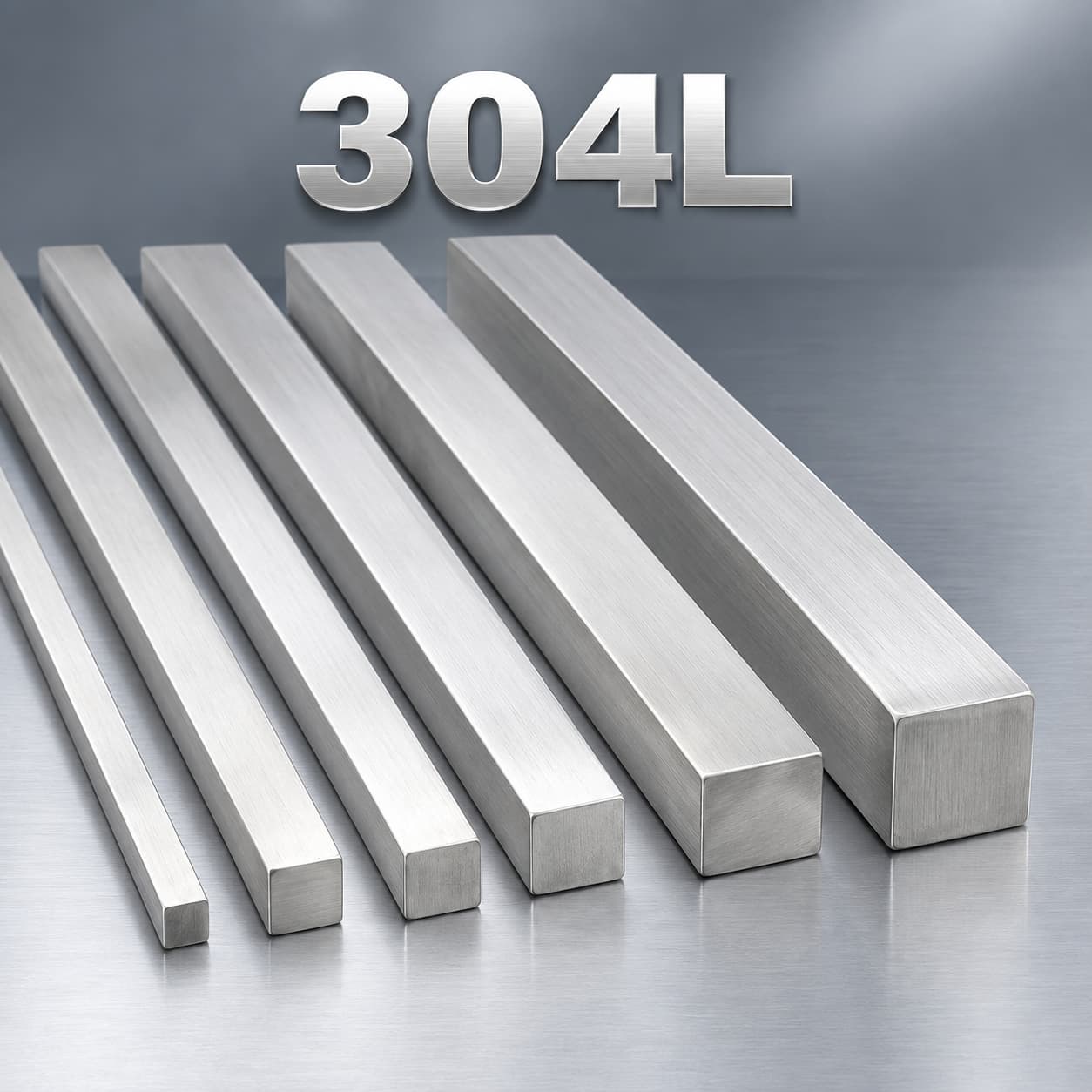
Grade: 304L/UNS S30403
304L stainless steel is a low-carbon version of the widely used 304 austenitic stainless steel. ”
“The reduced carbon content, limited to approximately 0.03% maximum, minimizes chromium carbide precipitation during welding and prolonged exposure to elevated temperatures. ”
“This characteristic improves resistance to intergranular corrosion and makes 304L particularly suitable for welded structures where post-weld heat treatment is not practical.
304L maintains the excellent general corrosion resistance, toughness, and fabrication properties associated with the 18Cr-8Ni stainless steel family. ”
“The chromium content provides a stable passive oxide film for corrosion protection, while nickel improves ductility, formability, and toughness. ”
“Compared with 304, 304L provides improved weldability and is preferred for large welded equipment, piping systems, and pressure-containing applications.
The alloy exhibits excellent forming characteristics, good machinability, and outstanding toughness at both ambient and cryogenic temperatures. ”
“It is non-magnetic in the annealed condition and can be easily fabricated by common processes including welding, bending, and cold forming.
304L stainless steel is widely used in chemical processing equipment, food and beverage equipment, pharmaceutical systems, heat exchangers, pressure vessels, piping, architectural structures, and general industrial components. ”
“It is commonly supplied in bar form according to ASTM, JIS, and EN stainless steel bar standards for manufacturing shafts, fittings, fasteners, and precision mechanical parts.
Standard Designations
| Standard | Designation |
| ASTM / UNS | Type 304L / UNS S30403 |
| JIS | SUS304L |
| EN | 1.4307 / X2CrNi18-9 |
Bar Production Standards
| Standard | Description |
| ASTM A276/A276M | Stainless Steel Bars and Shapes |
| ASTM A479/A479M | Stainless Steel Bars and Shapes for Pressure Vessel Service |
| ASTM A484/A484M | General Requirements for Stainless Steel Bars |
| JIS G4303 | Stainless Steel Bars |
| EN 10088-3 | Stainless Steel Bars and Rods |
Chemical Composition (Typical wt.%)
| Element | Value |
| Carbon (C) | ≤0.030 |
| Chromium (Cr) | 18.00-20.00 |
| Nickel (Ni) | 8.00-12.00 |
| Manganese (Mn) | ≤2.00 |
| Silicon (Si) | ≤0.75 |
| Phosphorus (P) | ≤0.045 |
| Sulfur (S) | ≤0.030 |
| Nitrogen (N) | ≤0.10 |
| Iron (Fe) | Balance |
Mechanical Properties (Annealed Condition)
| Property | Value |
| Tensile Strength | ≥485 MPa |
| Yield Strength (0.2% Offset) | ≥170 MPa |
| Elongation | ≥40% |
| Hardness (Brinell) | ≤201 HB |
| Hardness (Rockwell B) | ≤92 HRB |
| Density | Approx. 7.9 g/cm³ |
| Modulus of Elasticity | Approx. 193 GPa |
- Chemical processing equipment
- Food and beverage processing equipment
- Pharmaceutical equipment
- Pressure vessels
- Heat exchangers
- Welded piping systems
- Architectural structures
- Stainless steel shafts, fittings, and fasteners
- Cryogenic service equipment
304L stainless steel is a low-carbon version of the widely used 304 austenitic stainless steel. ”
“The reduced carbon content, limited to approximately 0.03% maximum, minimizes chromium carbide precipitation during welding and prolonged exposure to elevated temperatures. ”
“This characteristic improves resistance to intergranular corrosion and makes 304L particularly suitable for welded structures where post-weld heat treatment is not practical.
304L maintains the excellent general corrosion resistance, toughness, and fabrication properties associated with the 18Cr-8Ni stainless steel family. ”
“The chromium content provides a stable passive oxide film for corrosion protection, while nickel improves ductility, formability, and toughness. ”
“Compared with 304, 304L provides improved weldability and is preferred for large welded equipment, piping systems, and pressure-containing applications.
The alloy exhibits excellent forming characteristics, good machinability, and outstanding toughness at both ambient and cryogenic temperatures. ”
“It is non-magnetic in the annealed condition and can be easily fabricated by common processes including welding, bending, and cold forming.
304L stainless steel is widely used in chemical processing equipment, food and beverage equipment, pharmaceutical systems, heat exchangers, pressure vessels, piping, architectural structures, and general industrial components. ”
“It is commonly supplied in bar form according to ASTM, JIS, and EN stainless steel bar standards for manufacturing shafts, fittings, fasteners, and precision mechanical parts.
Standard Designations
| Standard | Designation |
| ASTM / UNS | Type 304L / UNS S30403 |
| JIS | SUS304L |
| EN | 1.4307 / X2CrNi18-9 |
Bar Production Standards
| Standard | Description |
| ASTM A276/A276M | Stainless Steel Bars and Shapes |
| ASTM A479/A479M | Stainless Steel Bars and Shapes for Pressure Vessel Service |
| ASTM A484/A484M | General Requirements for Stainless Steel Bars |
| JIS G4303 | Stainless Steel Bars |
| EN 10088-3 | Stainless Steel Bars and Rods |
Chemical Composition (Typical wt.%)
| Element | Value |
| Carbon (C) | ≤0.030 |
| Chromium (Cr) | 18.00-20.00 |
| Nickel (Ni) | 8.00-12.00 |
| Manganese (Mn) | ≤2.00 |
| Silicon (Si) | ≤0.75 |
| Phosphorus (P) | ≤0.045 |
| Sulfur (S) | ≤0.030 |
| Nitrogen (N) | ≤0.10 |
| Iron (Fe) | Balance |
Mechanical Properties (Annealed Condition)
| Property | Value |
| Tensile Strength | ≥485 MPa |
| Yield Strength (0.2% Offset) | ≥170 MPa |
| Elongation | ≥40% |
| Hardness (Brinell) | ≤201 HB |
| Hardness (Rockwell B) | ≤92 HRB |
| Density | Approx. 7.9 g/cm³ |
| Modulus of Elasticity | Approx. 193 GPa |
- Chemical processing equipment
- Food and beverage processing equipment
- Pharmaceutical equipment
- Pressure vessels
- Heat exchangers
- Welded piping systems
- Architectural structures
- Stainless steel shafts, fittings, and fasteners
- Cryogenic service equipment