Procuring nickel alloy materials is more complex than ordering standard steel. Nickel alloys are high-value, performance-critical materials where a grade mismatch, counterfeit material, or missing certification can lead to catastrophic equipment failure, costly project delays, and serious safety risks.
As an experienced nickel alloy manufacturer and global supplier, we work with buyers across aerospace, oil and gas, petrochemical, and marine sectors every day. In this guide, we share the essential factors every procurement professional and engineer should evaluate when sourcing nickel alloy materials.
1. Verify the Exact Grade and Standard
Nickel alloys are not interchangeable. Two grades that sound similar can have very different chemical compositions and performance limits. For example, Inconel 600 offers good oxidation resistance but lower strength than Inconel 625, which adds molybdenum and niobium for improved corrosion and high-temperature strength.
Always specify:
- Full alloy designation (e.g., “Inconel 625” not just “nickel alloy”)
- UNS number (e.g., N06625 for Inconel 625)
- Applicable ASTM / ASME / AMS standard
- Condition (annealed, solution-treated, cold-drawn, etc.)
At Detect Metals, all materials are clearly labeled with full grade identification and traceability codes from the original mill.
2. Select the Right Product Form
Nickel alloys are available in many forms, and choosing the right form directly impacts material yield, machining time, and total cost. The most common forms include:
- Sheet & Plate: Used for fabricating tanks, vessels, furnace linings, and structural panels. Available from thin gauge sheet up to thick plate.
- Bar & Rod: Used for machining fasteners, shafts, valves, and precision components. Available in round, square, and hexagonal profiles.
- Pipe & Tube: Seamless and welded options for process piping, heat exchangers, and hydraulic systems. Verify wall thickness tolerance and seamless vs. welded construction.
- Coil & Strip: Used for stamping, forming, and continuous production applications.
Many buyers overpay by ordering oversized bar stock or thicker plate than necessary. Work with your supplier to optimize form and dimensions for your specific fabrication process. Detect Metals offers custom cut-to-size services to minimize waste and reduce your machining costs.
3. Insist on Full Material Traceability and Certifications
Material certification is non-negotiable for nickel alloy procurement, especially in regulated industries like aerospace, nuclear, and oil and gas.
Minimum documentation you should require:
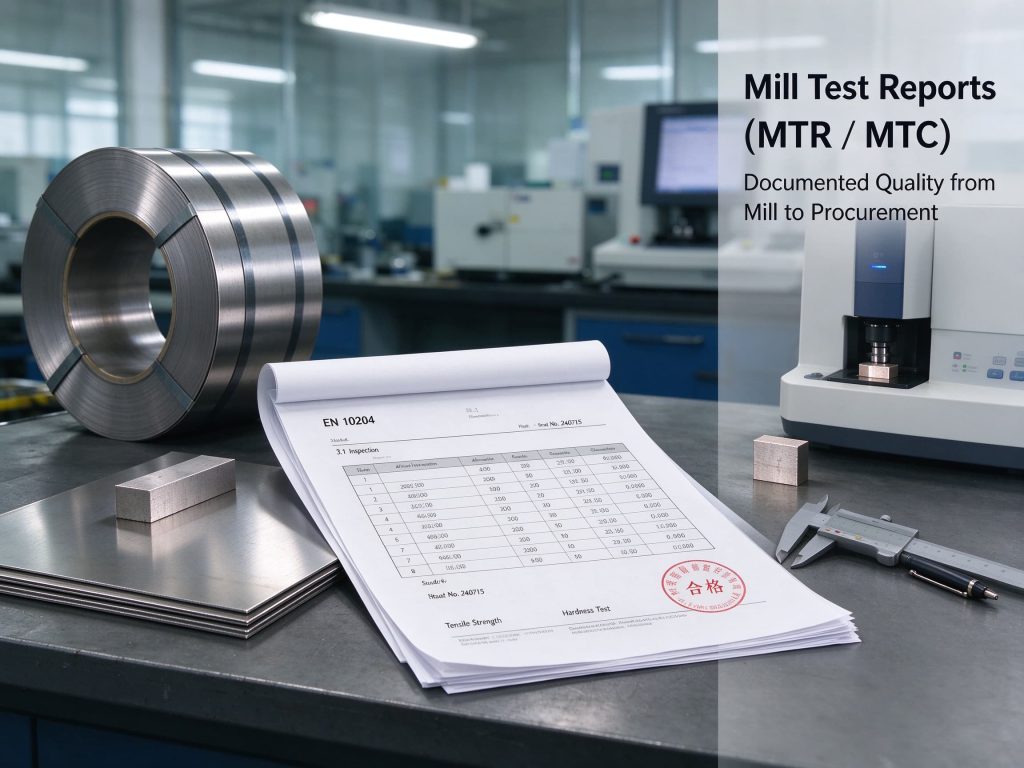
- Mill Test Certificate (MTC / MTR): Includes chemical composition analysis, mechanical property test results (tensile strength, yield strength, elongation, hardness), heat number, and standard compliance.
- Material traceability: Every piece should be traceable back to the original melt/heat through heat codes or stamping.
- Third-party inspection: For critical applications, consider SGS or equivalent third-party inspection reports.
- Compliance with industry standards: ASTM B168 for plate/sheet, ASTM B166 for bar, ASTM B167/B444 for pipe, and relevant AMS specifications for aerospace.
At Detect Metals, every shipment includes official mill test certificates, and we can arrange additional third-party inspection upon request.
4. Evaluate Supplier Capabilities Beyond Basic Stock
A reliable nickel alloy supplier does more than just sell material. Look for a partner that offers:
- In-house cutting and machining: Plasma cutting, waterjet cutting, saw cutting, and CNC machining to your exact dimensions.
- Technical support: Access to metallurgists who can advise on grade selection, heat treatment, and fabrication best practices.
- Global logistics experience: Knowledge of export regulations, packaging for long-haul shipping, and reliable freight forwarding.
- Flexible order quantities: Ability to support both small prototype quantities and large-volume industrial orders.
5. Watch for These Common Quality Red Flags
When evaluating quotes, be wary of prices that seem too good to be true. The nickel alloy supply chain has known quality issues including:
- Substitute or off-spec material sold under a premium grade name
- Missing or falsified mill certificates
- Material from unapproved mills with inconsistent quality
- Improper heat treatment that fails to achieve specified mechanical properties
The cheapest quote is rarely the lowest-cost option when you factor in rejected material, rework, and project downtime.
Why Buyers Worldwide Choose Detect Metals
Detect Metals is a trusted nickel alloy manufacturer, supplier, and distributor serving industrial clients across 50+ countries. We maintain comprehensive inventory of Inconel, Hastelloy, Monel, Incoloy, and pure nickel products in all standard forms, with full mill traceability and competitive factory-direct pricing.
Our commitment to quality means every order is verified before shipment, and our in-house fabrication team can deliver custom-cut materials ready for your production line. We support everything from small R&D batches to full-scale industrial projects, with reliable worldwide shipping and responsive customer service.
Ready to source nickel alloys with confidence? Contact Detect Metals today for a detailed, transparent quote tailored to your exact specifications.