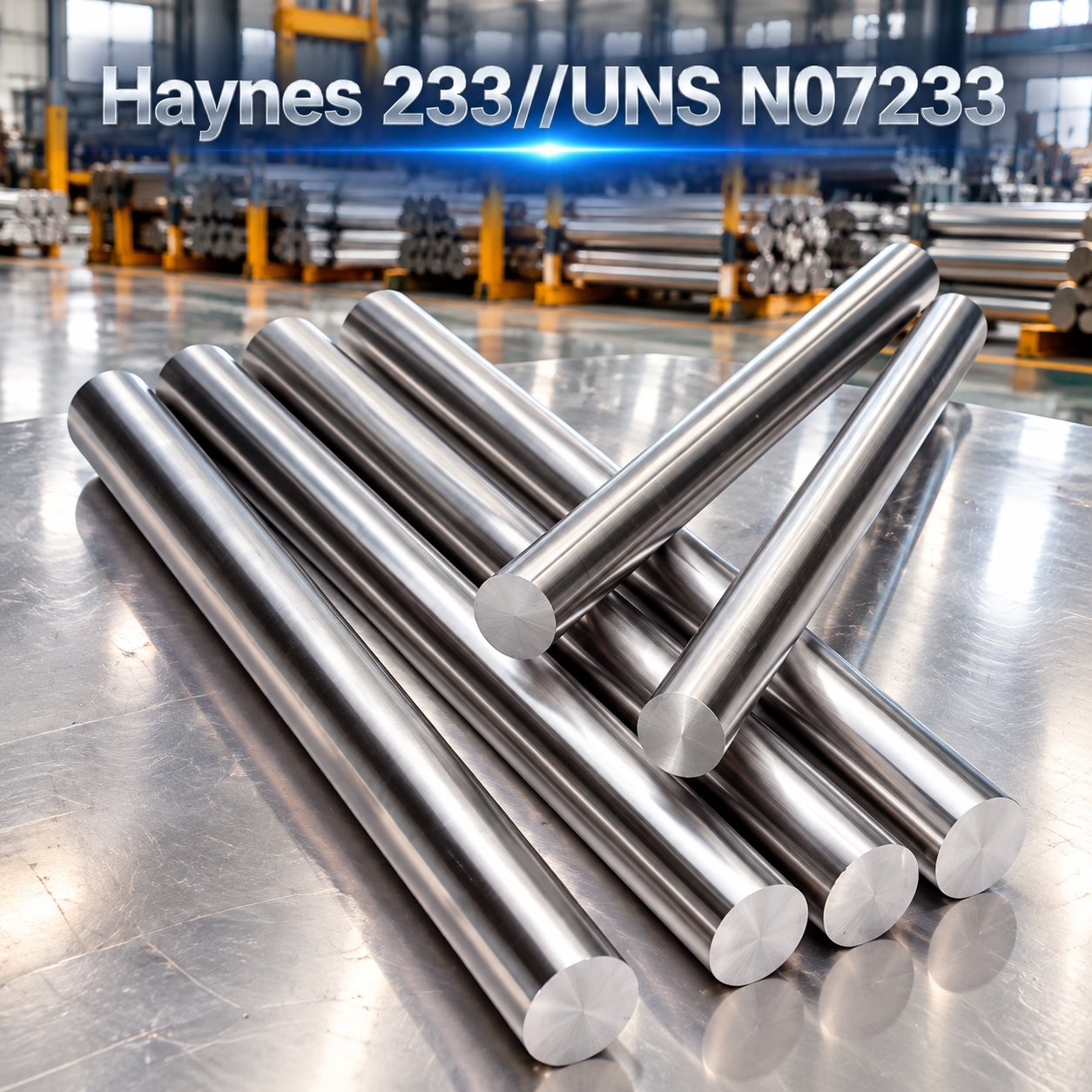
Grade: Haynes 233/Alloy 233/Nickel Alloy 233
HAYNES 233 alloy is a new Ni-Co-Cr-Mo-Al alloy that offers excellent oxidation resistance at temperatures up to 2100°F (1149°C) or higher coupled with superior creep strength – a combination of properties never before achieved in a readily fabricable alloy. The alloy obtains its exceptional oxidation resistance through the formation of a protective alumina layer, while the high creep strength is a result of solid-solution and carbide strengthening. Additionally, for use in intermediate temperature applications the alloy can be age-hardened by heat treatment to produce even greater strength. Finally, the alloy can be readily fabricated using conventional methods since it exhibits good hot workability, cold formability, and weldability.
| Nickel | 48 (Balance) |
| Chromium | 19 |
| Cobalt | 19 |
| Molybdenum | 7.5 |
| Titanium | 0.5 |
| Aluminum | 3.3 |
| Iron | 1.5 max. |
| Manganese | 0.4 max. |
| Silicon | 0.20 max. |
| Carbon | 0.1 |
| Boron | 0.004 |
| Tantalum | 0.5 |
| Tungsten | 0.3 max. |
| Yttrium | 0.025 max. |
| Temperature | 0.2% Yield Strength | Ultimate Tensile Strength | Elongation | |||
| °F | °C | ksi | MPa | ksi | MPa | % |
| RT | RT | 112.9 | 778 | 172.2 | 1187 | 27.3 |
| 1000 | 538 | 102.2 | 704 | 147 | 1014 | 25.8 |
| 1200 | 649 | 95.5 | 658 | 156.6 | 1079 | 25.5 |
| 1400 | 760 | 97.4 | 671 | 116.5 | 804 | 27.4 |
| 1500 | 816 | 82 | 565 | 92.3 | 637 | 21.6 |
▪ Hot gas components in aerospace and industrial gas turbines
▪ Industrial heating fixtures and sensors
▪ Various structural components in the emerging technology market.
HAYNES 233 alloy is a new Ni-Co-Cr-Mo-Al alloy that offers excellent oxidation resistance at temperatures up to 2100°F (1149°C) or higher coupled with superior creep strength – a combination of properties never before achieved in a readily fabricable alloy. The alloy obtains its exceptional oxidation resistance through the formation of a protective alumina layer, while the high creep strength is a result of solid-solution and carbide strengthening. Additionally, for use in intermediate temperature applications the alloy can be age-hardened by heat treatment to produce even greater strength. Finally, the alloy can be readily fabricated using conventional methods since it exhibits good hot workability, cold formability, and weldability.
| Nickel | 48 (Balance) |
| Chromium | 19 |
| Cobalt | 19 |
| Molybdenum | 7.5 |
| Titanium | 0.5 |
| Aluminum | 3.3 |
| Iron | 1.5 max. |
| Manganese | 0.4 max. |
| Silicon | 0.20 max. |
| Carbon | 0.1 |
| Boron | 0.004 |
| Tantalum | 0.5 |
| Tungsten | 0.3 max. |
| Yttrium | 0.025 max. |
| Temperature | 0.2% Yield Strength | Ultimate Tensile Strength | Elongation | |||
| °F | °C | ksi | MPa | ksi | MPa | % |
| RT | RT | 112.9 | 778 | 172.2 | 1187 | 27.3 |
| 1000 | 538 | 102.2 | 704 | 147 | 1014 | 25.8 |
| 1200 | 649 | 95.5 | 658 | 156.6 | 1079 | 25.5 |
| 1400 | 760 | 97.4 | 671 | 116.5 | 804 | 27.4 |
| 1500 | 816 | 82 | 565 | 92.3 | 637 | 21.6 |
▪ Hot gas components in aerospace and industrial gas turbines
▪ Industrial heating fixtures and sensors
▪ Various structural components in the emerging technology market.
Related products
-
Incoloy
Alloy 907 / UNS N19907
-
Incoloy
Alloy 903 / UNS N19903
-
Incoloy
Alloy 825 / UNS N08825
-
Incoloy
Alloy 330/Incoloy 330
-
Nickel Alloy
Alloy 36/UNS K93600
-
Hastelloy
Alloy C276/UNS N10276