When sourcing stainless steel for industrial projects, many buyers focus only on price, ignoring working-environment requirements. Wrong grade selection will cause pitting corrosion, cracking, early component failure and costly project downtime. This practical guide breaks down major stainless-steel families and helps you make better purchasing decisions for plates, pipes, bars, coils and fittings.
Main Stainless-Steel Families Overview
300-Series Austenitic Stainless Steel
300 series stainless steel is the most widely-used austenitic alloy group, including 304, 304L, 316L, 321, 310S, 347 grades. Featuring excellent corrosion resistance, great weldability and formability. 304 / 304L: General-purpose 18-8 stainless steel for food-processing equipment, architectural structures and general fabrication. Select low-carbon 304L for heavy-welding jobs to avoid inter-granular corrosion. 316 / 316L: Molybdenum-added grade for coastal, marine and mild chemical environments. Better resistance against chloride-induced pitting corrosion. Heat-resistant grades (310S, 321, 347): Designed for continuous high-temperature service in furnaces, boilers and heat-exchanger equipment.
400-Series Ferritic & Martensitic Stainless Steel
400 series stainless steel includes ferritic grade 430 and martensitic grades 420,440A/B/C. These grades are magnetic and can achieve high hardness via heat-treatment. 430: Cost-effective ferritic stainless steel for household appliances and decorative components. 420 / 440 series: High-hardness martensitic stainless steel for cutting tools, valve parts and wear-resistant mechanical parts.
Duplex & Super Duplex Stainless Steel
Duplex stainless steel (2205, 2304, 2507) combines austenite and ferrite microstructure. It delivers much higher mechanical strength plus outstanding chloride corrosion resistance. Ideal for offshore platforms, seawater desalination and heavy-duty chemical-processing facilities.
Precipitation-Hardening (PH) Stainless Steel
17-4 PH,15-5 PH,13-8-PH belong to precipitation-hardening stainless steel. They obtain ultra-high strength after aging heat-treatment, widely adopted for aerospace, high-pressure valve components and precision machinery parts.
Four Core Questions Before You Select Grades
- What is your service environment? Check exposure to humidity, salt spray, seawater, acid or high operating temperature. Chloride-rich environments usually require 316L, duplex or super-austenitic grades instead of ordinary 304.
- Do you need welding work? If heavy welding will be performed, prefer low-carbon “L” grades or stabilized grades such as 321 /347 to prevent weld decay.
- Mechanical requirements: strength, hardness or wear-resistance? High-strength structural parts can choose duplex grades. For high-hardness parts, martensitic or PH stainless steel should be considered.
- Total-life-cycle cost instead of unit-price only Lower-cost material may bring expensive replacement and maintenance cost. For harsh working conditions, investing in higher-grade alloys reduces long-term project risks.
Quick Reference Recommendation
General-purpose indoor & food-grade: 304 / 304L Coastal, salt-water, mild-chemical: 316L Offshore / seawater high-chloride: 2205 or 2507 duplex Furnace & high-temperature equipment: 310S,321,347 High-hardness wear-resistant components: 420,440C Aerospace high-strength precision parts: 17-4 PH, 15-5 PH
Final Notes on Sourcing
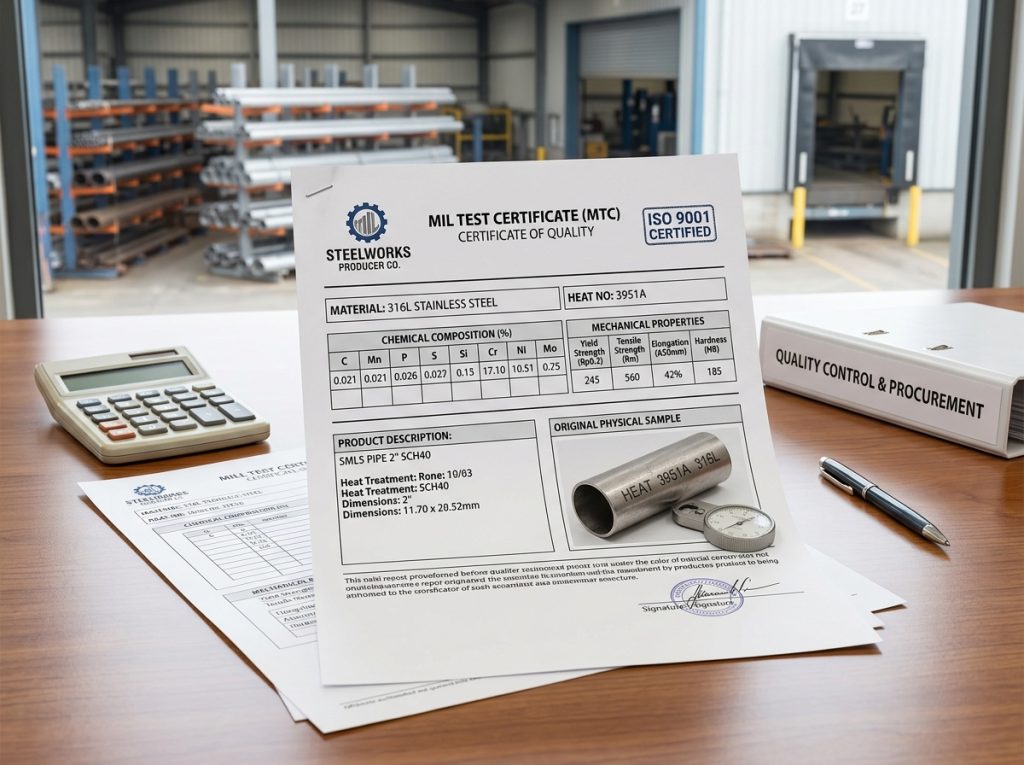
Even with correct grade selection, quality inconsistency from suppliers can still lead to failures. Always confirm material certification (MTR / MTC) before shipment.
At Detect-Metals, our technical team supports free grade-selection consultation according to your working-condition parameters. We supply full-range stainless-steel products including plate, sheet, pipe, bar, coil, mesh and pipe fittings, with complete ASTM-compliant mill test reports.
If you are unsure which grade fits your project, submit your requirements for a technical review and quotation.