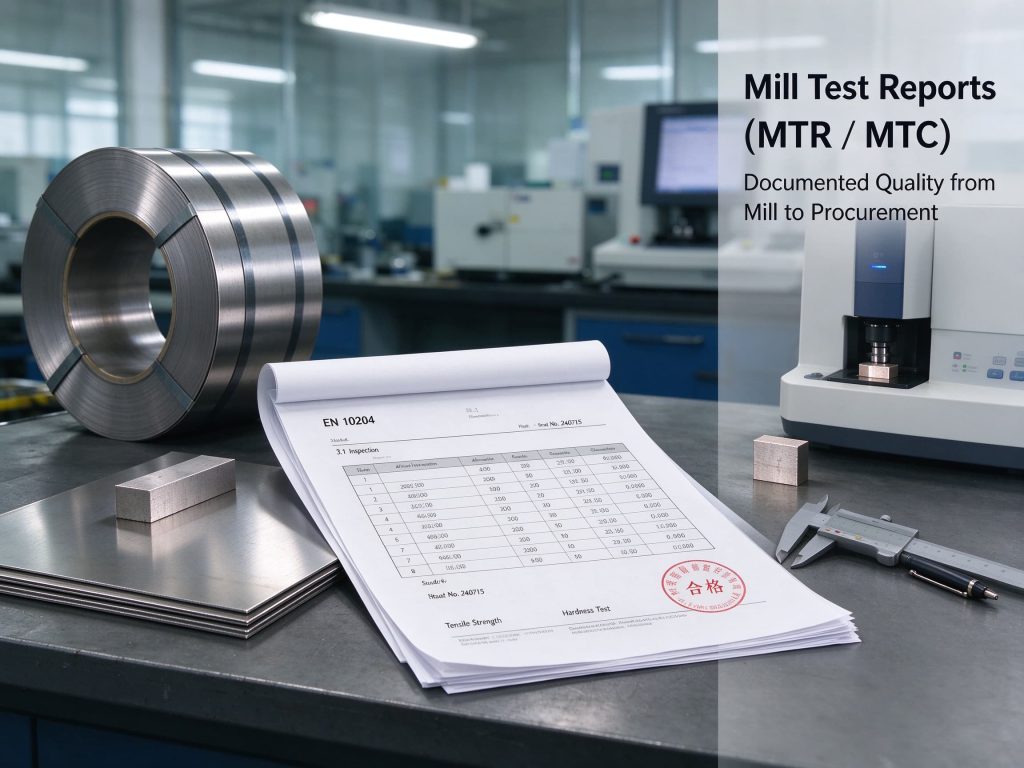
When buying industrial stainless steel, a low price per ton means little if the material lacks proper documentation. A Mill Test Certificate (MTC)—often called a Mill Test Report (MTR) or inspection certificate—is the official quality record issued by the steel producer or certified testing authority to verify that a specific heat or batch of metal meets agreed technical standards.
For global buyers, engineers, and quality teams, knowing what an MTC is and how to read it helps prevent costly alloy mix-ups, failed inspections, and compliance delays.
What Is a Mill Test Certificate (MTC)?
An MTC links a specific batch of steel back to its manufacturing heat or lot. It confirms the material’s grade, chemical composition, mechanical properties, and inspection results against standards such as ASTM, ASME, EN, or JIS.
In international trade, you will most commonly hear references to EN 10204 inspection documents—especially EN 10204 3.1 and EN 10204 3.2:
- EN 10204 2.2: Certifies compliance with the order based on non-specific inspection (routine/periodic testing rather than testing every specific batch).
- EN 10204 3.1: Certifies compliance with the order based on specific inspection of the actual product/heat supplied, validated by the manufacturer’s authorized inspection representative independent of the manufacturing department.
- EN 10204 3.2: Adds independent verification by a third-party inspector or customer-designated surveyor (such as SGS, BV, TUV, or Lloyd’s Register) in addition to the manufacturer’s inspection.
When sourcing stainless steel for structural, pressure, food, marine, or chemical applications, requiring a genuine EN 10204 3.1 (or 3.2 when project specs demand it) MTC is standard best practice.
Key Sections on a Stainless Steel MTC
Layouts vary slightly from mill to mill, but a complete stainless steel MTC typically contains the following sections:
- Header and Traceability Details Look at the top of the certificate first:
- Mill / Issuer Name and Address: Shows where the certificate originates.
- Certificate Number and Issue Date: Used for document control and audit trails.
- Heat Number / Lot Number: The most critical traceability number on the page. It must match the stencil or tag markings on the physical stainless steel plate or stainless steel sheet bundles you receive.
- Specification and Grade: Lists the governing standard (for example, ASTM A240/A240M or EN 10088-2) and alloy designation (such as 304/304L, 316L, or duplex grades).
- Dimensions and Quantity: Shows thickness, width, length, piece count, or weight.
- Chemical Composition This table lists the percentage by weight of alloying elements and residual impurities—typically C (carbon), Mn (manganese), P (phosphorus), S (sulfur), Si (silicon), Cr (chromium), Ni (nickel), Mo (molybdenum), and sometimes N (nitrogen) or stabilizing elements like Ti or Nb.
Check how the actual test values compare against the standard’s maximum or range limits:
- Corrosion resistance: Chromium and molybdenum levels are vital—for instance, molybdenum in 316/316L helps resist chloride pitting and crevice corrosion compared with standard 304.
- Weldability and sensitization: Lower carbon limits (such as in L-grades like 304L or 316L) help reduce carbide precipitation during welding.
- Mechanical Properties Mechanical test results demonstrate how the material behaves under load. Common entries include:
- Tensile Strength (Rm / UTS): Maximum stress the material can withstand while being stretched or pulled before necking/fracture (often reported in MPa or ksi).
- Yield Strength (Rp0.2 / YS): The stress level at which permanent (plastic) deformation begins (typically 0.2% offset yield strength).
- Elongation (%): How much the sample stretches before breaking over a specified gauge length, indicating ductility and formability.
- Hardness (HB, HRC, or HV): Useful for checking temper, condition, or compliance with service limits.
- Heat Treatment, NDE, and Sign-Off Depending on the product form and project specification, you may also see:
- Heat Treatment Condition: Such as solution annealed, quenched, or stress-relieved, which affects corrosion resistance and mechanical properties.
- Non-Destructive Examination (NDE) or Surface/Dimension Notes: For example, ultrasonic testing (UT) results on thicker hot rolled stainless steel plate or specialized materials like stainless steel clad plate.
- Authorized Inspection Sign-Off: Confirms the inspection type (such as EN 10204 3.1) and validation by the quality/inspection authority.
How to Read and Verify an MTC Step by Step
- Confirm the governing standard and grade: Make sure the standard, grade, and delivery condition match your purchase order and project drawings.
- Match the heat number to the physical goods: When delivery arrives, verify that the heat number on the MTC matches the markings on the tags, bundles, or plates. If the numbers do not align, quarantine the material until clarified.
- Check chemical limits element by element: Compare every reported percentage against the applicable standard limits—especially Cr, Ni, Mo, C, P, and S.
- Check mechanical values and units: Verify tensile strength, yield strength, and elongation meet minimum (or range) requirements, and pay close attention to units (such as MPa vs. ksi or mm vs. inches) so conversions do not trip you up.
- Check for red flags: Watch out for missing heat numbers, altered or blurry PDFs, missing chemical or mechanical test data required by the standard, or a mismatch between the stated EN 10204 level and who signed off on the test.
Why MTCs Matter for Your Supply Chain
Relying on verified mill documentation protects your fabrication schedule, simplifies customs and project audits, and reduces the risk of costly rework in the field. Whether you are ordering flat stock, cold rolled stainless steel sheet, or heavy plates, clear traceability gives your team confidence from quote to installation.
At Detect Metals, we supply stainless steel products backed by clear documentation, custom processing support, and reliable export service. Share your grade, thickness, and project requirements with our team to get a quote tailored to your specifications.