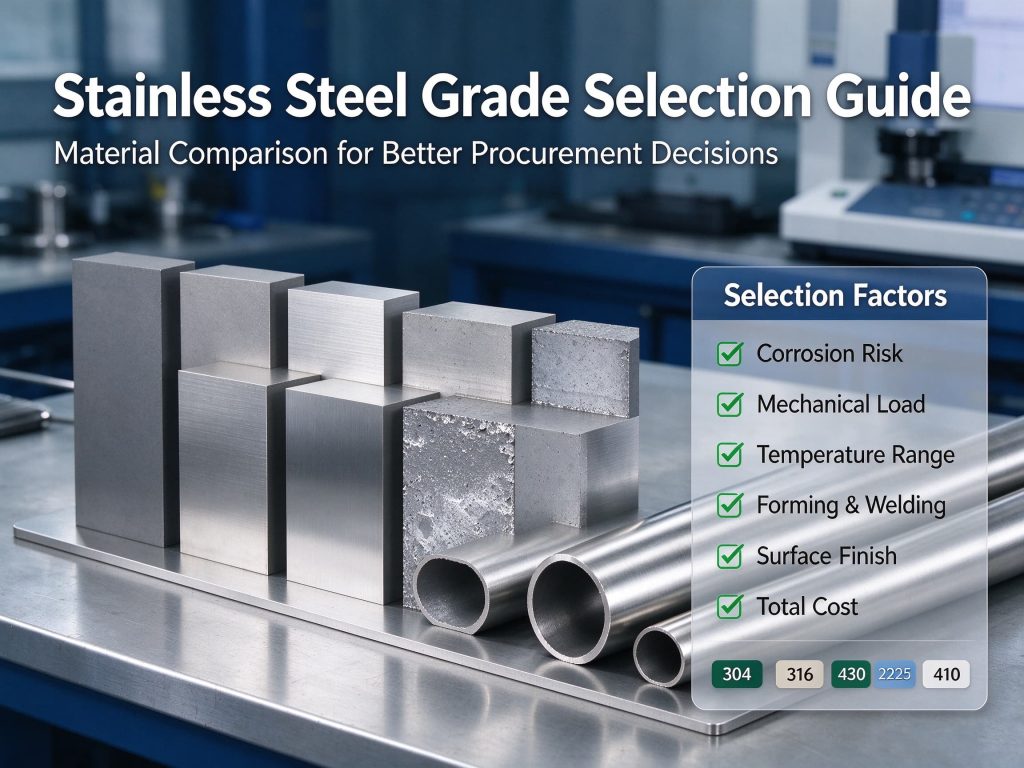
When sourcing 304 and 304L stainless steel for pressure vessels, piping systems, or welded fabrications, buyers often ask whether the “L” designation is strictly necessary. The “L” stands for Low Carbon, a modification engineered specifically to prevent corrosion failures after heavy welding.
Quick Verdict: Use 304L for any component requiring heavy-gauge welding (typically thicker than 6 mm) that will not undergo post-weld annealing. Use standard 304 for machined parts, lightly welded thin sheets, or high-temperature structural applications where slightly higher creep strength is required.
Comparison: 304 vs. 304L
| Parameter | Grade 304 (UNS S30400) | Grade 304L (UNS S30403) |
| EN / DIN Standard | 1.4301 | 1.4307 |
| Maximum Carbon (C) | 0.08% max | 0.03% max |
| Chromium / Nickel | 18–20% Cr / 8–10.5% Ni | 18–20% Cr / 8–12% Ni |
| Min Tensile Strength | 515 MPa (75 ksi) | 485 MPa (70 ksi) |
| Min Yield Strength (0.2%) | 205 MPa (30 ksi) | 170 MPa (25 ksi) |
| Sensitization Resistance | Moderate (risk in thick welds) | High (immune to weld decay) |
| Post-Weld Annealing Needed? | Yes, for corrosive service | No, usable in as-welded state |
1. The Metallurgical Difference: Carbon Content & Carbide Precipitation
The core difference between the two grades is the maximum allowable carbon content:
- 304 Stainless Steel: Maximum 0.08% carbon.
- 304L Stainless Steel: Maximum 0.03% carbon (less than half of standard 304).
Why Carbon Limits Matter During Welding
When standard 304 is heated to the sensitization temperature range of 425°C to 815°C (800°F to 1500°F)—which occurs naturally in the Heat-Affected Zone (HAZ) during welding—excess carbon combines with chromium to form chromium carbides along the grain boundaries.
This depletes the surrounding metal of chromium, destroying its passive protective layer and leaving the weld zone vulnerable to intergranular corrosion (weld decay). By capping carbon at 0.03%, 304L eliminates carbide precipitation, allowing fabricated tanks and pipelines to enter corrosive service immediately after welding without costly solution annealing.
2. Mechanical Strength Trade-Off
Because carbon acts as an interstitial strengthening element in austenitic stainless steel, lowering the carbon content slightly reduces the minimum guaranteed room-temperature mechanical properties of 304L:
- Tensile Strength: Drops by ~30 MPa (from 515 MPa in 304 to 485 MPa in 304L).
- Yield Strength: Drops by ~35 MPa (from 205 MPa in 304 to 170 MPa in 304L).
- High-Temperature Limits: Under ASME Boiler and Pressure Vessel Code (BPVC), standard 304 (or high-carbon 304H) is preferred for service temperatures above 425°C (800°F) because 304L has lower allowable design stresses at elevated temperatures.
3. What is Dual-Certified 304/304L?
Modern steel mills frequently produce dual-certified 304/304L plate, pipe, and bar. To achieve dual certification:
- The chemistry meets the strict ≤ 0.03% carbon limit of 304L.
- The mechanical properties are controlled (often via slight nitrogen additions within ASTM limits) to meet the higher 515 MPa tensile / 205 MPa yield requirements of standard 304.
Buying dual-certified material simplifies inventory management and ensures compliance with both weldability and structural strength specifications.
4. Industrial Selection Checklist
- Specify 304L when: Fabricating heavy-wall welded pressure vessels, chemical storage tanks, sanitary dairy/brewery piping, or structural frames exposed to acidic washdowns.
- Specify 304 when: Manufacturing CNC-machined fasteners, stamped thin-gauge enclosures, springs, or components operating continuously above 450°C.
Frequently Asked Questions (FAQ)
Q1: Does 304L cost more than 304?
Historically, 304L carried a slight premium due to decarburization refining costs. Today, because most mills produce dual-certified 304/304L as a standard stock item, the price difference is negligible or zero.
Q2: Which filler metal should be used when welding 304L?
Always use low-carbon ER308L (or E308L electrodes) filler wire when welding 304L so the weld deposit maintains the same ≤ 0.03% carbon threshold as the base metal.
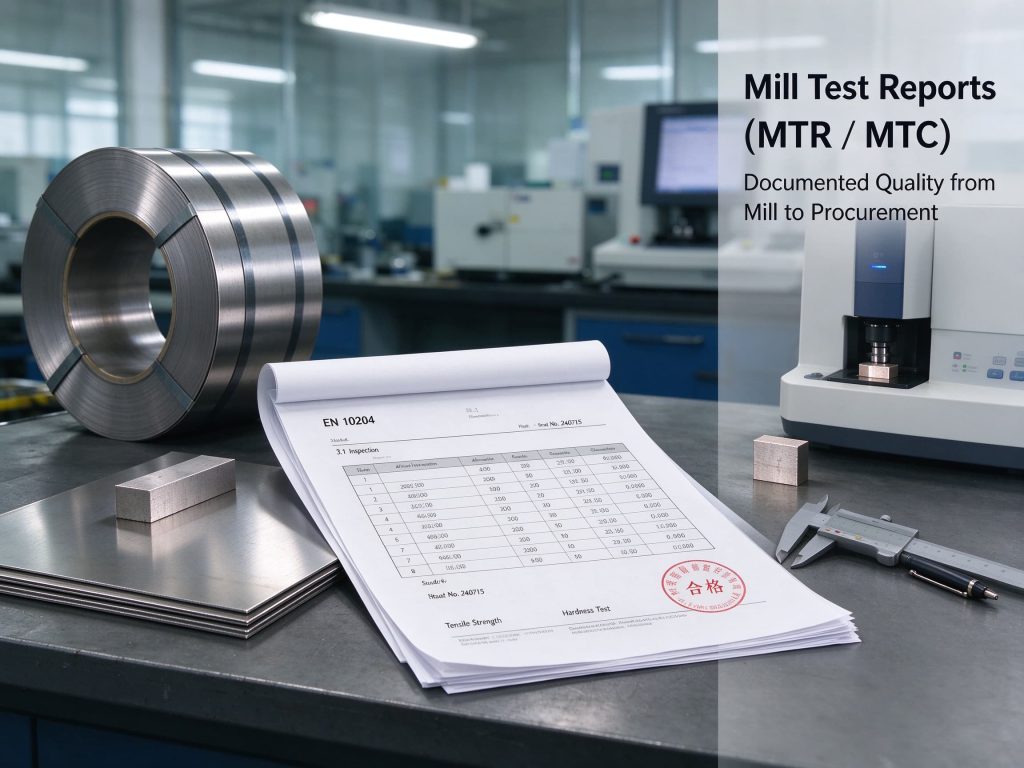
Looking for mill-certified 304, 304L, or dual-certified coils, sheets, and seamless pipes? Contact Detect Metals for fast B2B wholesale quotes.