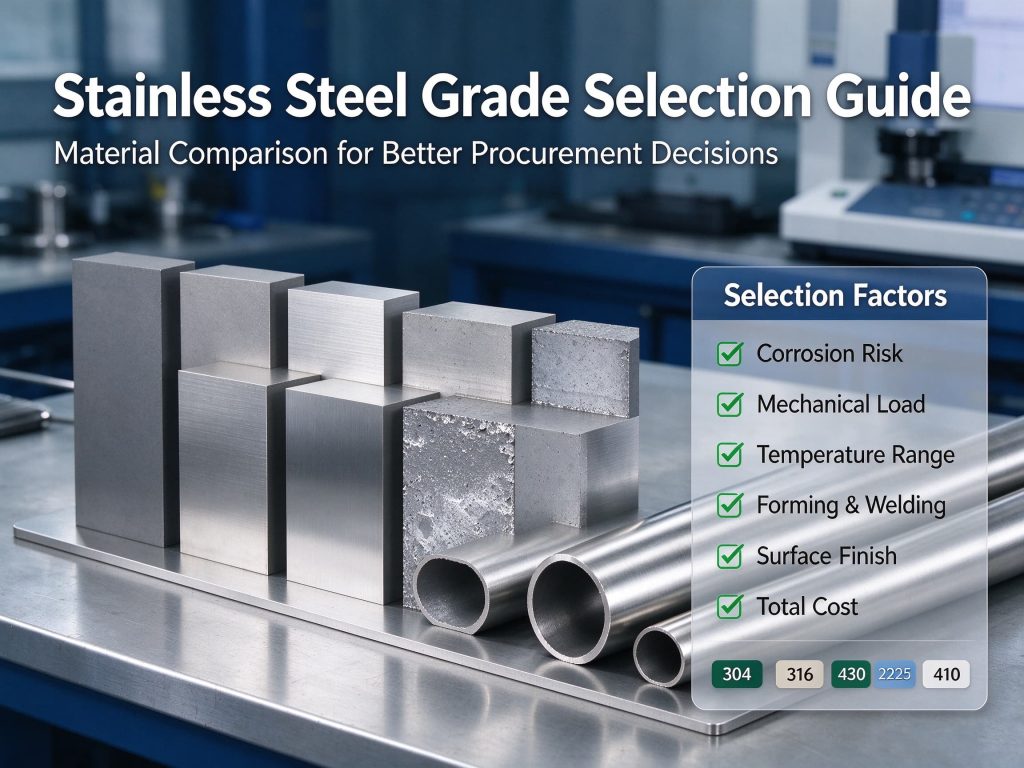
When specifying austenitic stainless steel for industrial equipment, structural components, or fluid handling systems, engineers most frequently compare Grade 304 (UNS S30400) and Grade 316 (UNS S31600). While both alloys look identical and share similar mechanical properties, their performance diverges sharply when exposed to chlorides, acids, and marine atmospheres.
Quick Verdict: Choose 304 stainless steel for general-purpose, indoor, or mildly corrosive environments where cost-efficiency is a priority. Choose 316 stainless steel when the application involves saltwater, de-icing salts, aggressive industrial chemicals, or pharmaceutical-grade sanitation.
Quick Comparison: 304 vs. 316 Stainless Steel
| Feature | 304 Stainless Steel (UNS S30400) | 316 Stainless Steel (UNS S31600) |
| EN / DIN Equivalent | 1.4301 | 1.4401 |
| Primary Alloying Elements | 18% Cr, 8% Ni | 16% Cr, 10% Ni, 2–3% Mo |
| Chloride Resistance | Moderate (prone to pitting in salt) | High (molybdenum prevents pitting) |
| PREN (Pitting Resistance) | ~18 – 20 | ~23 – 25 |
| Max Continuous Service Temp | ~870°C (1600°F) | ~870°C (1600°F) |
| Formability & Weldability | Excellent | Very Good |
| Relative Cost | Baseline (More economical) | ~20% – 35% higher than 304 |
1. Chemical Composition: The Role of Molybdenum
The fundamental metallurgical difference between 304 and 304L stainless steel versus 316 and 316L stainless steel lies in the addition of molybdenum (Mo) and slightly higher nickel content in Grade 316.
| Element | 304 Stainless Steel (%) | 316 Stainless Steel (%) |
| Carbon (C) | ≤ 0.08 | ≤ 0.08 |
| Chromium (Cr) | 18.0 – 20.0 | 16.0 – 18.0 |
| Nickel (Ni) | 8.0 – 10.5 | 10.0 – 14.0 |
| Molybdenum (Mo) | — | 2.00 – 3.00 |
| Manganese (Mn) | ≤ 2.00 | ≤ 2.00 |
| Silicon (Si) | ≤ 0.75 | ≤ 0.75 |
| Iron (Fe) | Balance | Balance |
Why Molybdenum Matters: Chloride ions break down the passive chromium-oxide layer on stainless steel, causing localized pitting and crevice corrosion. Adding 2% to 3% molybdenum stabilizes this passive film, dramatically increasing resistance to chloride-induced attack.
2. Corrosion Resistance in Industrial Environments
- Atmospheric & Freshwater Exposure: Both grades resist rust in clean air and freshwater. However, in coastal regions (within 5 miles of saltwater) or areas using road de-icing salts, 304 develops tea-staining and surface pitting over time, whereas 316 maintains structural and aesthetic integrity.
- Chemical & Acidic Media: Grade 316 outperforms 304 in sulfuric, hydrochloric, acetic, and phosphoric acid environments, as well as in hot organic fatty acids common in food processing.
- Chloride Stress Corrosion Cracking (SCC): Neither grade is immune to chloride SCC above 60°C (140°F). For severe high-chloride thermal environments, engineers should upgrade to duplex stainless steel such as Grade 2205.
3. Mechanical & Physical Properties
In the annealed condition, 304 and 316 offer nearly identical baseline strength, meaning structural load calculations rarely require changing wall thickness when switching between the two:
- Tensile Strength (Min): 515 MPa (75 ksi)
- Yield Strength, 0.2% Offset (Min): 205 MPa (30 ksi)
- Elongation in 50 mm (Min): 40%
- Hardness (Max): 201 HB / 92 HRB
- Density: ~8.00 g/cm³ (0.289 lb/in³)
Both grades are non-magnetic in the annealed state (though cold working can induce slight magnetism) and cannot be hardened by heat treatment.
4. Application Guide: When to Use Each Grade
Choose 304 Stainless Steel For:
- Indoor architectural trim, railings, and cladding
- Commercial kitchen equipment, sinks, and beverage storage tanks
- Automotive exhaust components and heat exchangers (non-marine)
- Fasteners, brackets, and structural frames in inland environments
Choose 316 Stainless Steel For:
- Marine hardware, boat fittings, coastal architecture, and desalination plants
- Pharmaceutical manufacturing vessels and cleanroom piping
- Chemical processing reactors, valves, and heat exchanger tubing
- Medical surgical instruments and implantable devices (typically 316LVM)
Frequently Asked Questions (FAQ)
Q1: Can you visually tell the difference between 304 and 316 stainless steel?
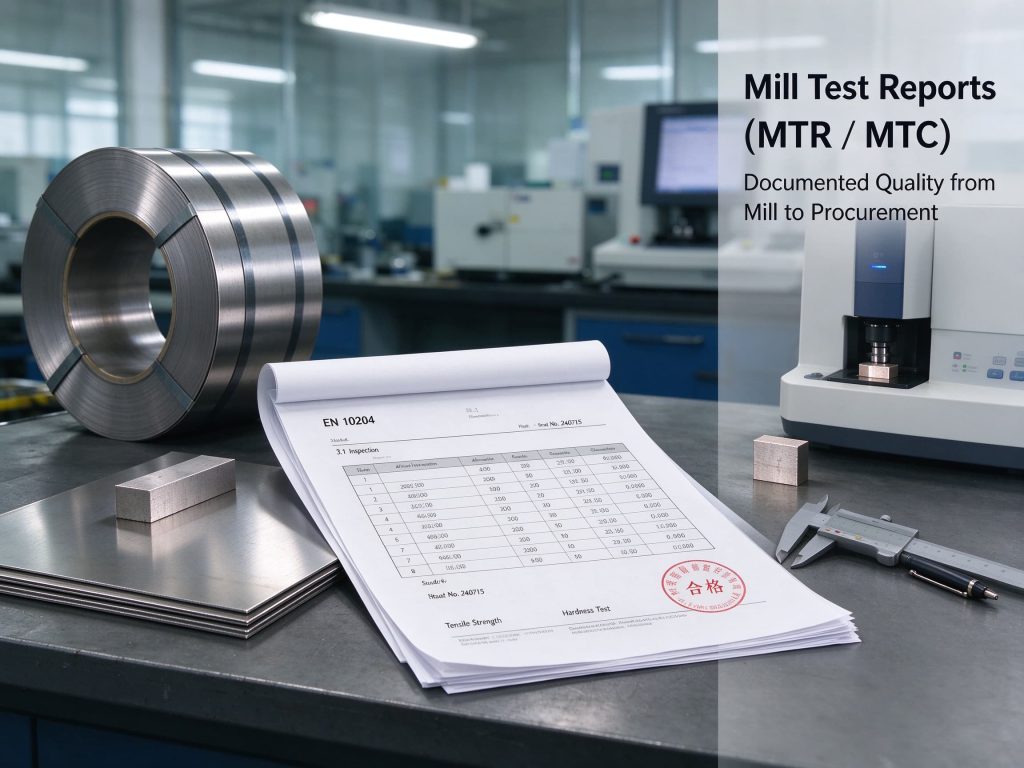
No. Both grades have the exact same metallic luster and surface finish. Verification requires a Mill Test Report (MTR), XRF alloy analyzer testing, or a molybdenum chemical spot test.
Q2: Is 316 stainless steel stronger than 304?
At room temperature, their yield and tensile strengths are virtually identical (205 MPa yield / 515 MPa tensile). However, 316 retains slightly better creep strength at elevated temperatures above 500°C.
Need certified 304 or 316 sheet, plate, pipe, or bar with full EN 10204 3.1 MTCs? Explore our full inventory at Detect Metals or request a quote for custom cut-to-size orders.