When designing high-integrity systems for chemical processing, power generation, and petrochemical refining, selecting the right tubular product form is just as critical as choosing the alloy grade itself. Engineers and procurement managers frequently face a pivotal choice: seamless or welded nickel alloy tubes.
Because nickel-based superalloys are deployed in the world’s most aggressive environments—where temperatures soar and aggressive acids or chlorides attack materials—the manufacturing route of a tube directly dictates its structural reliability, pressure containment, and service life.
1. Manufacturing Processes: How They Differ
The structural destiny of a nickel alloy tube is forged at its inception.
- Seamless Tubes: Manufactured via hot extrusion, rotary piercing, or cold pilgering from a solid billet. The process involves no longitudinal welds or filler metal. This yields a uniform, homogeneous grain structure throughout the entire circumference of the tube wall.
- Welded Tubes: Formed by cold-rolling a flat strip or plate into a tubular shape, then continuously welding the longitudinal seam using high-integrity fusion processes such as Gas Tungsten Arc Welding (GTAW) or Plasma Arc Welding (PAW), typically followed by cold working and annealing to homogenize the weld zone.
2. Defect Risks & Metallurgical Integrity
Each manufacturing method introduces distinct metallurgical risks that engineers must mitigate during procurement and inspection:
- Seamless Defect Profiles: Potential issues include surface imperfections, eccentricity (uneven wall thickness), and minor inclusion strings from the original billet. However, they possess no heat-affected zone (HAZ) from longitudinal welding.
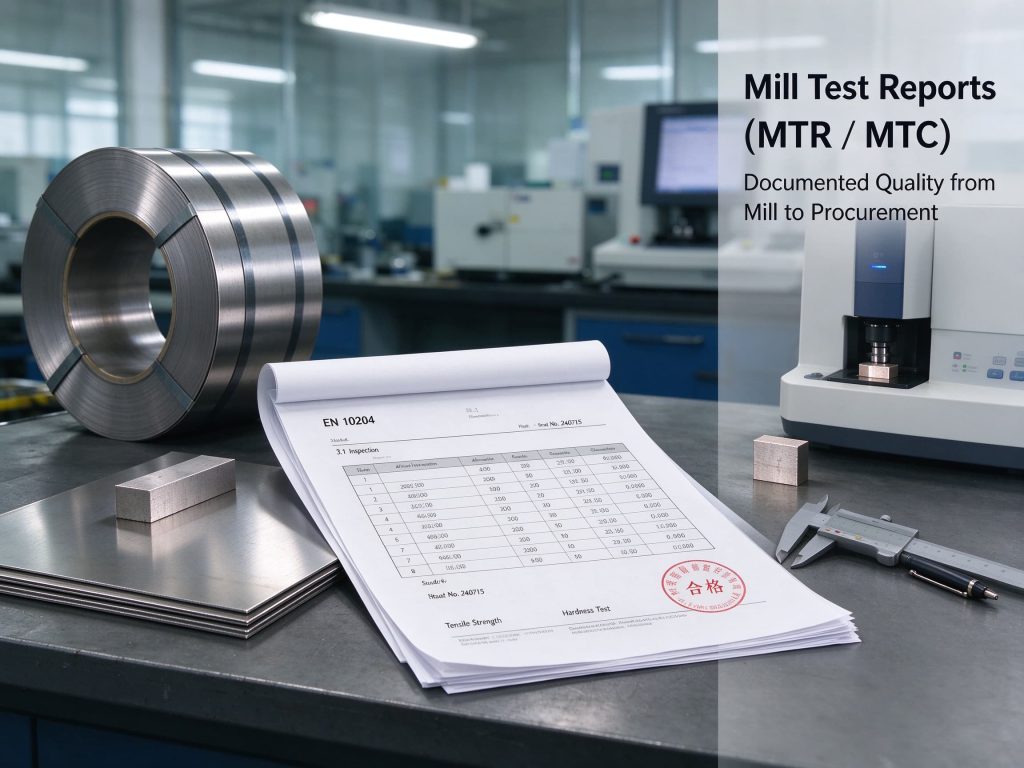
- Welded Defect Profiles: The primary concern historically centered on the weld seam—specifically, microfissuring, porosity, or lack of fusion if parameters drift. Modern automated welding combined with full solution annealing and stringent non-destructive testing (NDT) has largely mitigated these risks. Even so, verifying mill test reports through rigorous procurement quality checks is vital to ensure weld integrity.
3. Application Boundaries: Heat Exchangers & Process Piping
Operating parameters dictate whether seamless or welded pipe is specified:
- High-Pressure Process Piping: For high-pressure gas lines, high-temperature steam headers, and critical reactor loops, seamless tubes remain the default choice due to their isotropic mechanical properties and higher safety margins under severe cyclic loading.
- Heat Exchangers & Condensers: Welded tubes have gained widespread acceptance in shell-and-tube heat exchangers, especially in corrosive chemical plants. Because heat exchanger tubing is manufactured in massive quantities, welded options offer significant cost advantages and tighter outer diameter (OD) wall tolerances. When paired with proper alloy selection for severe chemical processing environments, modern welded nickel alloy tubes deliver exceptional longevity.
4. Comprehensive Comparison: Seamless vs. Welded
| Performance Parameter | Seamless Nickel Alloy Tubes | Welded Nickel Alloy Tubes |
| Pressure Containment | Superior; ideal for ultra-high pressure and thick walls | Excellent, governed by standard code design formulas |
| Weld Seam / HAZ | None | Present (requires solution annealing to match base metal) |
| Dimensional Uniformity | Can exhibit slight wall thickness variation (eccentricity) | Highly uniform wall thickness from precision flat strip stock |
| Cost & Lead Time | Higher cost, longer production lead times for specialty alloys | More economical, faster availability in standard sizes |
| Surface Finish | Typically pickled or cold-drawn; may require extra finishing | Smooth, uniform finish; interior bead can be controlled or rolled flat |
5. Standards, Specifications, and Inspection
Both product forms are governed by strict ASTM, ASME, and DIN standards (such as ASTM B163 for condenser tubing, ASTM B622 for seamless pipe/tube, and ASTM B626 for welded pipe/tube).
Regardless of whether you select seamless or welded, strict inspection standards must be enforced:
- Hydrostatic or Pneumatic Testing: To verify pressure boundary containment.
- Eddy Current / Ultrasonic Testing (UT): To detect internal discontinuities, volumetric flaws, or weld seam anomalies.
- Chemical & Mechanical Testing: Ensuring tensile strength, elongation, and corrosion resistance meet specifications.
Choosing between seamless and welded nickel alloy tubing requires a balanced assessment of operating pressure, corrosion severity, and project economics. While seamless tubes provide ultimate peace of mind for high-pressure, heavy-wall applications, advanced manufacturing and welding technologies mean that high-quality welded tubes perform exceptionally well in chemical plants and heat exchangers at a lower total project cost.